Category: Uncategorized

  • I CAN, I WILL PROGRAMME

    I CAN, I WILL PROGRAMME

    For the past month, I’ve been enrolled on a disability empowerment programme called the ‘I CAN, I WILL PROGRAMME’. This programme was structured to help me:

    • Scale new mountains!
    • Develop self-confidence
    • Focus on the things you can change
    • Enable me to plan for a more fulfilling and active lifestyle, and work potential
    • Support me to be more resilient and to cope with setbacks

    I had 90 minute workshops each week for 3 weeks:

    1. Session 1- “Doing what’s normal”
    2. Session 2- “Developing my resilience and self-confidence”
    3. Session 3- “Looking at work”
    4. 1 to 1 Empowerment Coaching Support

    In the first session, I’ve learned that our experience of living with disability is formative and character building. Disability is always represented by a wheelchair, when only 1.5% of the world are wheelchair users. We also discussed the difference between mindset vs skillset. Mindset is predetermined whereas skillset can be obtained.

    Then we talked about the different models of disability. The Social Model of Disability includes people’s views, opinions and attitudes. It has been the prominent approach to disability over the last 30+ years. It was developed by disabled people based on real life experience of discrimination and inclusion and challenging disabling barriers. It is outward looking and focused on the things in society that can be changed or improved, like, the environment, information, communications and people’s attitudes. It’s a problem solving approach which gives disabled people greater control over vital, even basic decisions, like, from what time to get out of bed on a morning to employability and education choices.

    This approach enables you to better understand how reasonable adjustments can be implemented, focuses on the things you can influence or change and promotes valued skills.

    The Individual Model of Disability is the medical aspect of disability. I also looked at, ‘what makes me ‘stand out’. The qualities that make me stand out are that I’m a good communicator, guidance and resilience.

    During the second session, we talked about developing resilience and self confidence. Other subjects included were, daily strategies for enhancing resilience and optimism.

    Then we took a SWOT assessment. During this assessment we looked at our strengths, weaknesses, opportunities and threats.

    We also discussed Google Mapping. In order to carry this out successfully, one must put their postal code on Google Maps. Then draw an inch to the set scale 2 miles and print. Then put the saucer onto draw round from your house. Finally, plot every business within radius to you. We also briefly discussed ‘Elevator Pitching’. Elevator Pitching is promoting your unique selling point. This method is used for CVs and Cover Letters.

    The course facilitator, Simon Cox, also suggested that Video CVs may be the best way to showcase a disabled jobseeker’s skills, qualities and work experience because in some cases, employers may only skim read or check the beginning of a CV, not the whole thing. Video CVs may help disabled candidates to stand a better chance at the application/ interview stage.

    In the third session, we talked about developing our ‘elevator pitch’ in five easy steps.

    1. Figure out what is unique about what you do.
    2. Make it exciting.
    3. Keep it simple.
    4. Write it down.
    5. Practice, practice, then practice some more.

    In the job application process:

    1. Be familiar
    2. Work your network
    3. Hone your pitch- Remember some 70% of jobs don’t go to advert but are filled through networks and word of mouth recommendations.

    In order to plan to move forward:

    • Read and highlight the information you like.
    • Keep learning and improving but be clear and focused on what.
    • Work on your goals and plans.
    • Share your goals and plans with others, especially the people close to you, those who can support you.
    • Engage your Work Coach in your plans, they can help.
    • No excuses|No procrastination|DO IT!

    “Do the productive and creative things you love to do- it is more likely to get done!”

    -Simon Cox

    We also looked at the subject of having a disability/health condition and finding work.

    How to apply ways that can support you in making a faster way to work and how to manage your disability or health condition better include the following:

    Get the doctor on your side

    • Clarify and confirm a diagnosis. Be sure to get a full and understandable diagnosis for your condition.
    • Ask questions to explore treatment options and what would be right for you. Write down your questions and take them with you.
    • What further information do you need- specialist services, self help groups.
    • What exercise and stretching does your GP recommend you do?
    • Have you reviewed the best medications to support you?
    • Ensure you have a personal treatment plan.

    The right work is good for you

    • Have you shared with your Work Coach what you have done in the past and what you are good at?
    • How does your daily and weekly routine’s inform and shape what you can do to return to work or just get more active?
    • Think widely about the kinds of work you can do now or in the future. When your personal health situation changes, then so too might your work goals and abilities but remember to think how you can use your knowledge and skills in different ways.
    • Keep up to date on your area of work/interests or sector use contacts, news and specialist journals.

    Effective condition self-management and control

    • Remember you are the expert on your health or disability.
    • Your Work Coach can support you towards, or into work or help you improve your quality of life helping you to get more active.
    • Why not make a plan of the things in life you want to improve or do better? Maybe it’s what you choose to eat, how you exercise your daily routine and activities and how you manage your available time.
    • A plan will give you a focus and purpose with some clear goals.
    • Seeing yourself achieve and progress your plan will make you more confident and feel good about yourself.
    • Discuss with your Work Coach what you think you need to help you keep moving forward.

    “If you don’t know where you’re going, you might end up someplace else.”

    Yogi Berry

    Support for improving mental health

    • Firstly, it’s very common to feel down and worried about things when you are also experiencing other health challenges.
    • By discussing your mental health with your GP or a specialist adviser or counsellor you can get the right support to help you manage your situation.
    • Ask about counselling or Cognitive Behaviour Therapy (CBT) and if they would help you?

    Physical activity-exercise and stretching

    • By getting more active not only will you feel better about yourself, it will also help you to improve your health and feel better.
    • Start with gentle exercise and build it up such as a walk in the park, cycling or dancing. Be aware of your limitations, so don’t over do it.
    • Cardio-vascular exercise- Your heart pumping and a little out of breath- is known to be good for your physical and mental health.

    Ergonomic Solutions-adjusting the way work is done

    • Technological advances mean almost all jobs and how they are done has changed.
    • Research the way jobs are done and how you might do it with your disability, condition or limitations.
    • An employer has a duty to make ‘reasonable adjustments’ to a job if due to a disability you experience a disadvantage. This means looking at how the job might be done differently to accommodate your needs as with equipment, aids, adaptations or changes to processes or procedures.
    • With the right adjustments disabled people are productive and effective employees.
    • Explore ‘Access to Work’ for help that’s available.

    Another topic we discussed are the core employment skills for success which are:

    • BASIC SKILLS
    • PERSONAL SKILLS
    • JOB ATTAINMENT

    At the end of the programme, I had a one to one interview with course facilitator Simon Cox. During the interview, we discussed my future career plans and goals. Even though I have a degree in History and Politics, I’ve decided to explore Accessibility Consultancy as a career option. I’ve carried out some research on the career field and gained some contacts as well. I’m looking at doing a qualification for it in order to gain more knowledge experience.

    This course has really helped me focus on my career and get organised in planning for my future. I am happy that I completed it. As a disabled jobseeker, I would really recommend this course to other disabled jobseekers who are trying to start or change careers.

  • Mythbusters!!!

    “Myths and Misconceptions

    People make silly assumptions about people with disabilities. Many people form preconceived ideas about the disabled community at large. From personal experience, here are just a few: MYTH 1. DISABILITY IS A DEVASTATING PERSONAL TRAGEDY WITH NO CURE.
    • The Truth- The lives of disabled people are not tragic. The solution to disability is to remove the environmental and attitudinal barriers which are the real causes of the disabling process.
    MYTH 2. SOMEONE WITH A MENTAL HEALTH CONDITION IS LESS INTELLIGENT.
    • The Truth- There is no connection between mental health and intellectual ability. A quarter of people in the UK will have a mental health condition at some time in their lifetime regardless of their IQ score.
    MYTH 3. BLIND PEOPLE ACQUIRE A SIXTH SENSE.
    • The Truth- Other senses may be used to gain accurate information but there is no such thing as a sixth sense.
    MYTH 4. CHILDREN SHOULD NOT ASK PEOPLE ABOUT THEIR DISABILITIES.
    • The Truth- Some adults find the natural, uninhibited curiosity of children embarrassing. Reprimanding children for asking questions may cause them to think there is something ‘bad’ about disability. Most disabled people will not mind answering a child’s question.
    MYTH 5. DISABILITY AND ILLNESS ARE INTERRELATED.
    • The Truth- Disabled people are not necessarily sick but are subject to the same illnesses as any other person.
    MYTH 6. DISABLED PEOPLE ALWAYS NEED HELP AND MAY BE DEPENDENT.
    • The Truth- Being physically unable to do something does not cause dependency-not being able to drive is solved by using the services of a bus or train company. Disabled people may require different services and it is only when choice over those services is removed that dependency occurs.
    MYTH 7. MOST DISABLED PEOPLE ARE UNABLE TO HAVE SEXUAL RELATIONSHIPS.
    • The Truth- People with disabilities, like other people, are sexual beings. They can have relationships and children.
    MYTH 8. DISABLED PEOPLE ARE BRAVE AND COURAGEOUS.
    • The Truth- The experience of disability requires an adaptation of lifestyle rather than bravery and courage. It should be viewed, in many ways, as similar to any other significant life event.
    MYTH 9. WHEELCHAIR USE IS CONFINING- USERS ARE LITERALLY ‘BOUND’.
    • The Truth- A wheelchair, like a shoe or a car, is a mobility aid that enables a person to get around. Wheelchair users are restricted by an environment that has been designed for able-bodied living.
    MYTH 10. THE EXPECTATIONS OF DISABLED PEOPLE DIFFER FROM OTHERS.
    • The Truth- Disabled people go to school, work, form relationships, do their laundry, eat, get angry, pay taxes, laugh, have prejudices, vote, plan and dream like anyone else.
    So now that I’ve exposed these myths, this article should bring awareness and end the stigma of disablism and ableism.
  • ‘EMPOWER YOURSELF’

    ‘EMPOWER YOURSELF’

    By: Daniella Jade Lowe

    ‘Making a plan to improve your life’

    ‘When you can’t control what’s happening, challenge yourself to control the way you respond to what’s happening. That’s where your power is.’

    Empowering oneself requires independence, and choosing the way you respond to each challenge you face in life. Displaying self-control in negative situations, is another way to access your inner power in order to empower yourself. Planning ahead is another way of maintaining control and empowering yourself, especially in the ‘disabling world.’ It helps you to stay in control of your life and your future.

    The Disability Experiential Cycle

    Everyone with a disability goes through, what is considered, the Disability Experiential Cycle. This cycle consists of the time span of your life, quality of life and well-being behaviour in the ‘disabling world’. During this cycle, we experience all sorts of feelings like denial, shock, blame, confusion, frustration and adjustment. While experiencing these feelings, there are things that we can do to improve our lives.

    What is it like living with a disability or a long- term health condition?

    You must be a problem solver, resourceful, determined and attentive to detail. You also need good communication skills, as well as empathy with the businesses and customers. We also must be creative, adaptable and flexible. Developing my own independence causes me to empower myself.

    How is this relevant to the kind of work you want?

    All advocates and Politicians should have these qualities. Journalists also need these skills.

    Do you share customer characteristics then say how?

    Yes. The customer characteristics that I share are:

    • I’m always connected
    • I can be opinionated
    • I’m value conscious
    • I trust
    • I seek authenticity
    • I require immediacy
    • I follow rituals

    Within the Individual Model of Disability there is no cure, whereas, within the Social Model of Disability, there is a cure.

    In relation to the Social Model of Disability, there is the ‘Disabling World’ which brings multiple discrimination. There are also issues of isolation, lack of financial independence, segregated or poor education, language, charity model, attitudes, fear, lack of inclusion, charging for services, lack of accessible transport, lack of accessible loop, steps, BSL interpreters, overprotective families, access to information, poor job prospects, negative media, poverty, stereotyping, ignorance, building design, prejudiced attitudes, charities’ offensive images of disabled people and housing.

    In reference to the Individual Model, there’s also stereotyping. Most times when people mention disability, they always use the wheelchair symbol which can be demeaning and is misleading as not all disabilities are physical.

    What are your hopes and dreams for the future?

    I am an aspiring Politician and Disability Advocate.

    What is it that limits your opportunities or holds you back?

    I am a wheelchair using, unemployed, university graduate with very little work experience.

    What do you want to do about this, what actions will make a difference?

    I’m actively job-searching and improving my skills. I’ve elevated myself through having a blog, CV, Cover Letter, Reference Letter and good educational background.

    What is in our power to change?

    The power is in managing our well-being. We should always consider what we truly have to offer an employer. We have the power to choose who we connect with. There’s power in what we choose to learn and get better at. There’s also power in self-motivation, self-confidence and how resilient we are.

    Identify Life and Work Aspirations

    My Life goals include Journalism and Politics. Journalism and Politics are my passion. This is a short term life goal. Life skills are required such as good IT skills, good reading skills, good writing skills and good communication skills.

    My Work goals include disability advocacy. Disability Advocacy is a long-term life goal that I have. I already have a university degree in BA History and Politics to help me achieve this goal. I could potentially complete a Masters Degree in Journalism or Social Work to help me accomplish my goal. I’ve also contemplated becoming a Disability Consultant.

    Employment skills needed are interpersonal skills, communication skills, time-management, money-management.

    What holds me back?

    A Lack of opportunities. A Lack of work experience. A Lack of training. For some of us, discrimination. I need to improve my interview skills.

    What limits my opportunities and choices?

    Wheelchair accessibility and lack of work experience.

    What are the barriers that get in my way?

    Barriers that get in my way include Disability, lack of training and lack of work experience.

    What can I do about the things that block me?

    Find ways to overcome obstacles or improvise. Ask for help. Create a personal accountability network.

    What should we have in a plan?

    Identify the problem and come up with a solution. Then set deadlines. Create small, manageable, attainable and reachable tasks to meet each deadline. Encourage yourself along the way with personal declarations, quotes and affirmations. Create a personal inventory and set goals. Get a personal counsellor, work coach or therapist to help you.

    What do we want in our Improvement Plan?

    I need to work on self-confidence, work on developing resilience like managing stress. I can also work on marketing for jobs, job search skills and tactics, as well as, how to explain the gap in my CV, personal presence, real work experience, introductions with employers and more.

    What are our top priorities for action?

    Top priorities for action are Job-searching, career-mapping, blogging, interviews, and improving skills. Starting your own business is another plan of action that can be used as a source of income.

    Future Collaborations

    Now we have some great ideas to work on, how will we do it?

    We can collaborate through group meetings, phone calls and emails.

    How often should we do this?

    This could be done either daily, annually, monthly, or quarterly.

    Who do we want to involve?

    I would involve employers. I’d involve my Work Coach. I would include support organisations like Reed in Partnership, Leeds Job-centre, and University Careers Office. I would include other Individuals. This could include family members and friends for accountability. I may also want to involve sponsors for additional financial support. I may even get some legal advice.

    These are some of the ways that you can empower yourself especially if you have a disability. These are some of my recommendations that I would make to the ‘disabling world’ at large!

  • ‘What it takes to be ME’

    Independence

    A typical day in my life, requires lots of motivation, dedication and can be time-consuming. Being independent while having a disability, requires one, like me, to be assertive and diligent. It also requires me to be an independent thinker and show personal initiative and interest in my personal affairs.

    Practising independence helps me to empower myself. Having a life of independence through disability, forces me to prioritise, manage time and advocate for myself by any means necessary. This means that I have a lot to think about. Independence, to me, is a combination of freedom and maturity at a high level. The good thing about independence for me is that it allows me to learn, mature and try new things. It means taking control of my life. Exercising independence, also causes me to be more resourceful and creative. The bad thing about independence for me is that it exposes my strengths, weaknesses, insecurities and worries.

    However, independence for a person like me living with Spina Bifida and Hydrocephalus, creates more worries and fears for my friends and family, than me. For example, as a student, I remember meeting with the International Office at the Bradford College, and during this meeting they seemed more concerned about me getting homesick, than they were about me completing my A-Levels. Despite this, I overcame and finished. The truth about this matter called independence is that my parents and guardians won’t always be around to help me. This is ultimately the main motivator. Everyone likes independence, but I think those who are physically challenged value their independence more than the average able-bodied person because they experienced a limited level of it.

    Statistically, patients with Spina Bifida frequently experience social isolation with limited employment opportunities and restriction of independent living, neurological and intellectual impairment, and orthopaedic and urological consequences of their condition, unlike the average able-bodied person. This is why living independently is a big deal for me.

    As I reflect on my college and university years, I’ve learned that my diet was critical. As a freshman in college, I neglected myself in the area of nutrition and diet while studying. As a result, I lost weight and experienced skin break down which subsequently resulted in pressure sores and hospitalisation. Ever since then, I have started and maintained a high protein diet. This is so important for me because a non-wheelchair user, doesn’t have to worry about pressure sores, if they neglect themselves and lose weight. Pressure sores can also be life threatening if ignored or mistreated. I also attend the annual Spina Bifida Clinic in London where I get a general check-up to make sure everything is okay and to focus on what I need to improve. Unfortunately, the Chelsea and Westminster Hospital in London is the only hospital in all of England that provides these clinics twice a year. These clinics have helped me to improve my health.

    Nutrition

    Nutrition is also critical in my daily routine because it helps with general health, skin repair and maintenance. As part of my dietary needs, I’m expected to maintain a high protein diet. In relation to being born with Spina Bifida, nutrition is pivotal because, according to research, Spina Bifida occurs due to a lack of Folic Acid in a pregnant woman’s diet. Research also suggests that Spina Bifida and other congenital disabilities are the result of obesity. So nutrition is an important factor for me. All of this cost money.

    Source of income

    I receive my income through benefits. I also have a Go Fund Me account. This is how I support myself financially. I am currently an unemployed university graduate with a BA degree in History and Politics, actively job searching just to get extra work experience to start my career. Even though I have the ability to work, I never had a job as a student. Journalism and Politics are my passion.

    I aspire to be a Disability Advocate through politics. As a Disability Advocate in Politics, I will always endeavour to be an advocate for people with special needs. I will teach them to empower themselves. I will also hold disability forums to discuss the topic series, ‘Dealing with Disability’. I will discuss themes like, Dealing with Disability in the Church, Dealing with Disability in the Home, Dealing with Disability in the Workplace, Dealing with Disability in the Education System and Wheelchair Accessibility.

    I will use these forums to come up with solutions to improve the lives of people with disabilities and to help them empower themselves. I have contemplated starting a business but I’m not sure what type of business to start. I have also contemplated being an Accessibility Consultant.

    Wheelchair accessibility
    Compared to Bermuda, wheelchair accessibility is great in England. I’m currently living in a housing complex, under a housing scheme focused on those living with disabilities. It is wheelchair accessible for wheelchair users like me. All residents meet with the landlord on a quarterly basis, to express their living needs and concerns. We discuss rent issues, Housing benefit, communal laundry issues and maintenance. We also have annual Christmas parties and summer Barbecues.

    The college and university that I attended were fully wheelchair accessible. This is positive compared to Bermuda. All throughout my education in Bermuda, it was hard to find a school that was fully accessible for a wheelchair user. England’s education system in general is quite progressive and conducive for students with disabilities.

    My only analysis of the British system is that they have a dictatorial way of doing things. In my opinion, they tell you what they think you need, instead of you telling them what you need. I know this from personal experiences because when I moved to England from Bermuda after being accepted into the Bradford College, I was instructed to invest in an electric wheelchair without an official assessment. I disagreed with this decision because, according to Wheelchair Services, people who cannot self-propel, only, qualify for an electric wheelchair. But I am thankful, because it makes mobility faster. My electric wheelchair is also height adjustable which makes it easier to reach high objects and counters. The downside to using an electric wheelchair is that the traction of the wheels makes it harder and more dangerous to move through snow and rain. Mud is also bad for the wheels.

    Transportation : Bermuda versus UK

    Transportation is great in England. I can catch the trains, buses and taxis. Taxis and trains are equipped with portable ramps. However, when ordering taxis, I must specifically ask for a wheelchair taxi. Wheelchair taxis are usually equipped with either portable or remote -controlled ramps. The only problem that I have with using taxis is that the prices that they charge a wheelchair user aren’t always consistent. In other words, they tend to take advantage and overcharge wheelchair users. I only tend to catch taxis if there’s inclement weather or if I’m running late and I don’t know where a certain venue is. Trains and buses are very reliable from prices and assistance to accessibility. Wheelchair users are always urged to book assistance by phone before travelling on the train. Unfortunately, Bermuda has been a different experience. Not many wheelchair users take public transportation due to inaccessibility. This causes the disabled community to be more dependant on family and friends, which stifles independence.

    Personal Care

    I am responsible for my own personal care, but I do have carers to help me with domestic tasks twice a week through an agency called Dignicare. They were assigned to me through my Social Worker. I also receive additional support from a disability service, called the Shine Charity who are dedicated to supporting individuals and families as they face challenges arising from Spina Bifida and Hydrocephalus. I am also seen by District Nurses on a quarterly basis. The bathroom in my house is equipped with rails to make transfers easier.

    Using public bathrooms can be uncomfortable and in-conducive at times. For example, I don’t like using the airport bathrooms in England, while travelling, because I have to wait for the security guard to bring the key to unlock the bathroom door, instead of having the luxury to go in and out as I please. But at least they’re wheelchair accessible.

    Since graduation, I’ve found this part of my life interesting and quite stressful, but overall, I look forward to starting my career doing what I love. This is what it takes to be me. That’s how I roll!!!

  • MY EXPERIENCES AT THE MOVEMENT 2 WORK PLACEMENT

    By: Daniella Jade Lowe

    From January 29th- February 23rd, 2018, I had the wonderful opportunity to be involved in the Movement 2 Work Placement at the Park Place Jobcentre in Leeds, through the Department of Works and Pensions. I originally found out about this placement at the Guiseley Jobcentre through my Work Coach last year.

    In preparation for this placement, I met with the Health and Safety Team about a risk assessment on the 19th of January, which is protocol for all wheelchair users. I’m happy with everything. I got two evacuation buddies and a mentor. I get tea and lunch breaks on the placement. I was given a personal tour of the building. I was based on the ground floor. I did Job shadowing and Customer Service work. I got my own access fob. There were three refuge points in case of fire and two wheelchair accessible bathrooms. There was a lift as well, but I didn’t need to use it. The kitchen was also accessible.

    My placement officially started on the 29th of January, which was Induction Day. I met my Work Placement Advisor who gave me a refresher tour of the Jobcentre. He also gave me my workbook. The staff are caring, friendly and knowledgeable about their role and the Jobcentre itself. I believe that this Work Experience will help to boost my CV and career in general. I can also use the knowledge and skills gained to apply for other jobs.

    On Tuesday I job shadowed my supervisor Angela who helped customers find and apply for jobs. The main skill learned was time management. The main quality of a Jobcentre is Labour. They use Labour Market Systems and Labour Market Units to help customers. This experience can help me to improve my organisational skills.

    On Wednesday I job shadowed my supervisor Steph who carried out Habitual Residence Tests in an AJCS diary using DCams. Habitual Residence Tests are oral, online tests, carried out in interview style, for refugees seeking benefits. DCams are like a claimant commitment. Appointments are booked through these. You can find all customer details on it based on National Insurance numbers. I learned that you need to be very organised and have a good memory. You should also have good communication skills, listening skills, body language and general interview etiquette. They tend to use abbreviations a lot, but abbreviations can help improve memory and time management. It also helps you to be organised.

    On Thursday morning I job shadowed and observed a Habitual Residence Test. I saw Steph use the DCams again. I also did some photocopying. Thursday afternoon, my supervisor Paul showed me how the Universal Credit Department works. I learned to be observant. I also learned how to improve organisational skills and how to improve memory.

    Friday morning I observed HRTs. Friday afternoon I joined a group session to do personal job searching. By doing this, I learned teamwork as I helped others in job searching. I was also more motivated to job search as I worked in a group. In the future I should try to complete tasks with other people to improve my time management and motivational skills. This can also improve communication skills.

    During the latter part of my second week, I got to explore the Finance Department and Universal Credit Department. I also experienced my first bomb alarm. That’s when my Risk Assessment and Evacuation Plan came in handy. During the alarm everyone gathered in the middle of the room and we were escorted out of the building with the Wardens and Evacuation buddies. We all stood outside, across the street from the Jobcentre, waiting for the signal that it was safe to go back inside. Once it was over, we went back inside and continued working.

    In reference to my opinion on disability awareness, wheelchair accessibility and equality, I feel that the staff did an excellent job. I am very happy with the way everything panned out. My only criticism or suggestion is that the kitchen door should be automatic because it is difficult if a wheelchair user has to hold a hot drink or food, push their wheelchair and hold the door open simultaneously. I didn’t venture upstairs because there is no evacuation chair in case of a fire or bomb which would leave me stranded.

    Other than that, I enjoyed my time at Park Place Jobcentre. I wasn’t allowed to start the placement until the risk assessment was carried out, which means that they take their duty of care very seriously. They made reasonable adjustments for me. I am thankful. The culture of the clientèle was pleasant and friendly. The workers were predominantly women. There were some similarities to my career of choice. Interviewing is a big part of what Jobcentres do to help people find employment and claim benefits. Interviewing is also a big part of Journalism which is part of my career goals. Although Customer service at the Jobcentre isn’t what I’d do as a career, it was good to explore this profession. I would like to officially thank the Park Place Leeds Jobcentre Plus and the Department of Works and Pensions for making the necessary adjustments for me to do this placement.

  • My Life

    My Life

    My name is Daniella Jade Lowe. I was born on October 26, 1991. I am a wheelchair user because I was diagnosed with Spina Bifida and Hydrocephalus at birth. Spina Bifida is basically a spinal cord injury. I was conceived in Bermuda. Then I was admitted to Harley Street private room with all family in attendance. However, the baby monitor was turned on and the doctor left the room during which time the nurse seeing all was in order turned off the monitor. Some time later the doctor returned to the birthing room and was horrified that the baby monitor was turned off. Once turned on again, the doctor noticed that I was in distress, growing tired not having sufficient strength in my legs to push myself out. I was immediately sent to Hammersmith and West London Hospital and spent perhaps three weeks in an incubator. My mother was moved to Queen Charlotte’s for recovery. She visited me every day for three weeks.

    I was a hungry baby and begun eating cereal as soon as she was returned to the homestead in London. Parents met with Doctors and specialists on a regular basis whilst in England. Prognosis was not good but parents chose to have faith and believe God for His outcome. On returning to Bermuda, we went through registration with a paediatrician who recommended a shunt be inserted into Brain for ventricle drainage. I went to Ohio for a second opinion and where I had a successful operation and recuperated over six weeks. I enjoyed preschool privately and at Gwen’s Wonderland, Bermuda. I entered East End Primary School, Bermuda and it was suggested that I be immediately admitted to a modified program. I was given the opportunity to have the same education as my peers. In other words, I was mainstreamed instead of being put into a special class or special program. The Bermuda Government instituted an inclusive program in the Department of Education. I received occupation therapy, physiotheraphy, learning support etc. With proper and professional help I moved through the educational system successfully. I had three different paraprofessionals.

    My favourite subject in school was English. The subject that I dreaded in school and still dread today was Math.  But I try my best. My favourite colour is yellow. I like writing, social media and going to the cinema.

    I’ve had many great friends throughout my school life. One friend that I had in school was named Carlton Tuzo. I met him at the Clearwater Middle School, Bermuda. He was a very friendly and helpful person. Whenever I needed help around the school, he would always be there to carry my book bag when my Para-educator had to lift my wheelchair and I up the stairs, or he would sometimes push me around the school to help me get to class. He always took initiative and was a very genuine person.

    In relation to vocation, my original plan was to start my career working for a newspaper as a Journalist in Political Science, after graduation, then, after a couple of years, or when I get tired of that, work my way into becoming a Politician. Fortunately, I’ve completed my History and Politics Degree. I have contemplated completing a Masters’ Degree in Journalism, but not yet. I ultimately want to be an advocate for people with special needs through Politics. Journalism and Politics are my passion. I’ve already represented Bermuda at the London 2012 Paralympic Games as a reporter. It was a breath-taking experience. I look forward to doing more.

  • My Aspirations

    My name is Daniella Jade Lowe and I am an aspiring Journalist. In fact Journalism and Politics are my passion. I have been part of many Journalism opportunities and projects. For example, I’ve represented Bermuda at the London 2012 Paralympics as a reporter for Paralympian Jessica Lewis. Check out the link to my Facebook page below!

    I am very committed to whatever I do. I show initiative. I am good at planning projects and getting them done in a timely manner.

    Another aspiration that I have is Politics. I aspire to be a Disability Advocate. As a Disability Advocate, I will advocate for their rights while teaching them how to empower themselves. I’ve even considered marketing myself as an accessibility consultant. I can help businesses in creating plans to help people with special needs navigate the towns, city’s etc.

    In relation to being an accessibility consultant, I’ve been advised to take up Social Work as another course, which may help me in this.

    Access consultants provide professional advice on how to develop inclusive environments in accordance with the Equality Act 2010. They help to reinforce the law.

    Wheelchair Accessibility and mobility issues are just some of the problems that access consultants look at and try to solve. Access alleviates the amount of limitations and restrictions on wheelchair users. Failing to ensure wheelchair accessibility is neglecting to provide reasonable adjustments. It is like functioning in dysfunction. Access Rating is a prime example of what access consultants do.

    Proposal for Access Consultancy


    Dear Employer,

    I am writing regarding your requirement for delivery of confidence building/ awareness workshops.

    Currently I help businesses in creating plans to help people with special needs navigate the towns and cities, and I feel this puts me in a position to deliver such workshops.

    I have attached my proposal which I believe would meet your requirements.

    I look forward to hearing from you.

    My name is Daniella Jade Lowe. I have a disability. It doesn’t completely define me; it just enhances me in a way which differentiates and strengthens me. My disability should be viewed as an ability: to see the world in a different way. I am an Accessibility Consultant. I help businesses in creating plans to help people with special needs navigate the towns, cities etc. I charge $75 for my services as an Accessibility Consultant.

    As a wheelchair user, I have advocated for Wheelchair Accessibility in Bermuda, by writing various articles for numerous publications on the subject. I also have a blog where I also write about various disability related issues.


    During Middle School and High School, I used a Garaventa StairTrac to navigate the school for classes.
    In fact, one of the reasons why I pursued further education and started my career in England was due to Wheelchair Accessibility. During College, I became the Disability Officer for the Students’ Union and I advocated for the students with disabilities.


    On July 27, 2007, I was invited by former Premier of Bermuda Dr. Ewart Brown for a ‘Brown Bag Lunch’ to discuss issues like Wheelchair Accessibility amongst other things. I have also been sporadically involved with WindReach since I was young.

    Anything to be an agent of change, especially in the lives of those with special needs. DECISIONS! DECISIONS! I want to make a difference in my lifetime and generation.


    MY TIME AT THE  PARALYMPIC GAMES

    https://www.facebook.com/PaparazziattheParalympics/
    Daniella-Jade Lowe

  • ‘How I Overcame’

    ‘How I Overcame’

    By: Daniella Jade Lowe

    My educational experience as a disabled student has not been easy. Every step of the way has been a learning curve and a fight one way or the other with many hurdles to overcome. I graduated from Berkeley Institute, Bermuda in June 2009. After receiving a deferred offer from the University of Essex in England, I originally pursued further education at Bermuda College. However, I found that this was not possible as there was no wheelchair accessibility and they didn’t offer the degree of preference. As an alternative, I was referred to Snowdon Reid, a college recruiter from the Bradford College, through Bermuda College.

    I enrolled at Bradford College to do my A levels. However, I only did that course from 2009-2010. On my own, I had to persuade faculty that I was willing to cope with living by myself and studying. Despite concerns, I maintained the mentality and focus that I needed to complete college in order to gain more UCAS points to get into university. I met with fierce opposition from English Tutor who gave me the impression that she was discriminating against me due to just being in a wheelchair. I sought help to deal with this but eventually dropped the subject.

    I felt that the A levels were more stressful, intense and competitive than my degree. However, I still found ways to get things done. At one point, I got one to one tutoring online to help with my A Levels. I was allowed to stay. Snowdon Reid was a good advocate. I also had a Support Worker named Joan Pheasant from SHINE Charity who helped me apply for benefits and gave me personal advice for independent living. It was a difficult first year. There was lots of snow which made navigating hills tough. I used lots of taxi’s. I did all shopping by myself, paying bills, buying groceries and balancing funds. I started using an electric wheelchair for travelling to college and back. I also attended El-Shaddai Church, where I made lots of new friends and support. The main friend I met was Bruce. Another good advocate and friend that I met was Karl Oxford who also used to attend El Shaddai Church and was also a member of the Directorate of the Bradford College. I eventually repeated the first year after failing my final exams.

    From 2011-2013, I had Personal medical issues to overcome, with ongoing visits to doctor office on campus. I ended up getting additional Health and Social Care which included a Social Worker, carers, and District Nurses to help cope with general heath while studying. During my Second year, I completed an Access course in Humanities and Social Sciences. It was a-2-year course. In the end, I graduated with a Diploma.

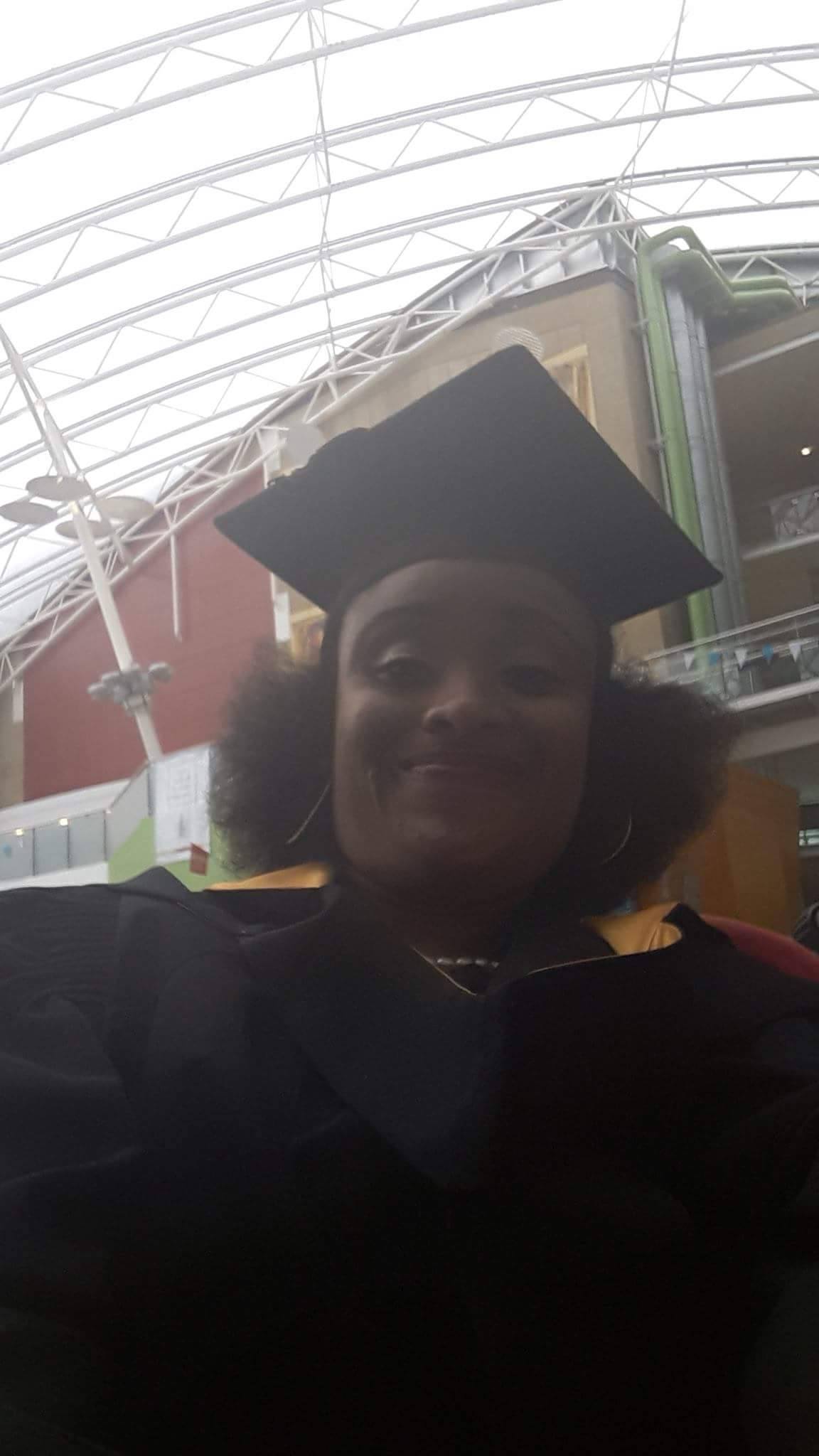
    From 2013-2017, I completed an undergraduate degree in History and Politics. After registering with the Disability Office, I got a Study Coach and specialist equipment. I repeated the first year after not satisfying requirements to pass. During my Second year, things were ok. In my third year, I, along with the rest of my peers, received a Dissertation Supervisor in addition to my Study Coach to help satisfy requirements and the External Board of Examiners. On July 19th 2017, I graduated from university, with Second Honours. I’ve now moved to llkley to gain work experience. I am an aspiring journalist, politician and advocate for people with special needs. Despite the hurdles and challenges faced, overall, studying in England has been worthwhile and enjoyable.

    My saga in looking for employment has been interesting so far. In addition to creating my own LinkedIn and Universal Jobmatch accounts, I’ve sent several applications and been turned down. I’ve been attending Jobcentre meetings. I’ve even visited Remploy in Leeds but they couldn’t help me. My Care Navigator and I visited Clarke Foley Centre where I’ve got voluntary work so far, every Wednesday from 9:30-12:30 as a receptionist. I’ll be answering the phone as well as helping with their bulletin, selling event tickets and social media.

  • The Journey Begins

    Thanks for joining me!

    Good company in a journey makes the way seem shorter. — Izaak Walton

    post