Tag: views

  • Understanding Legally Blind vs Visual Impairment: Key Insights

    I’ve always wondered why some people were called legally blind while others were called visually impaired. In my opinion, ‘legally blind’ almost sounds racist. As if you need to qualify to be ‘legally blind’. Make that make sense. This also shows a huge display of intersectionality. This is also an example of stereotyping.

    A meme featuring a green dinosaur with a thoughtful expression, overlaid with text questioning the concept of being 'illegally blind' in relation to 'legally blind'.

    Now, let’s address the controversy surrounding intersectionality. Critics often view it as a form of political correctness on steroids. They argue that it pits people against each other in an “oppression Olympics” rather than promoting inclusivity.

    However, it’s essential to recognize that intersectionality aims to understand and address complex inequalities, not create divisions.

    If 20/20 vision is the standard of optimal eyesight than why are there different versions?

    There’s levels to this.

    “Legally blind” is a recognized classification for individuals with significant visual impairment, while “illegally blind” is not a standard term in medical or legal contexts.


    Legally Blind
    Definition: The term “legally blind” refers to a specific level of visual impairment defined by government agencies, particularly in the United States. To be classified as legally blind, a person must meet one of the following criteria:


    Visual Acuity: A corrected vision of 20/200 or worse in the better-seeing eye. This means that what a person with normal vision can see at 200 feet, a legally blind person can only see at 20 feet, even with corrective lenses.


    Visual Field: A visual field of 20 degrees or less, which is often referred to as “tunnel vision”.

    Implications: Being classified as legally blind can affect a person’s eligibility for various benefits, including disability assistance, vocational training, and access to low vision aids. It does not imply total blindness; many individuals who are legally blind still have some usable vision.

    Illegally Blind
    Clarification: The term “illegally blind” is not recognized in medical or legal terminology. It does not have a defined meaning and is not used to classify any form of visual impairment. The concept of being “illegally blind” may arise from misunderstandings or miscommunications regarding legal blindness or total blindness. In essence, there is no legal or medical framework that supports the existence of “illegally blind” as a classification.


    Conclusion
    In summary, “legally blind” is a formal classification used to determine eligibility for various services and benefits for individuals with significant visual impairments.

    In contrast, “illegally blind” is not a recognized term and does not have any established meaning in the context of vision impairment. Understanding these distinctions is crucial for navigating discussions about visual disabilities and the support available to those affected.

    This is The view from where I Sit versus the view from where you Sit!!!

    Legally blind: What does it mean? – All About Vision 

    What Is Considered Legally Blind – Healthline 

    https://eyemantra.in/eye-diseases/legal-blindness/

    https://english.stackexchange.com/questions/155719/whats-the-origin-of-rob-someone-blind

    blind | Etymology of blind by etymonline 

    Legally blind: Definition, treatments, and support – Medical News Today 

    Understanding Legally Blind: Definition & Causes 

    What does it mean to be legally blind? | Lentiamo 

    What Does It Mean to Be Legally Blind? – WebMD 

    Evolution and Inclusive Language: Creating a New Term for Visual Disabilities – BlindNewWorld

    https://www.afb.org/online-library/unseen-minority-0/historical-chronologies/history-education-visually-impaired-people

    Before Braille: A Brief History of Visual Impairment and Education PT 1 

    https://disability-studies.leeds.ac.uk/wp-content/uploads/sites/40/library/bolt-Bolt-From-Visual-Impairment.pdf

    https://www.colourblindawareness.org/colour-blindness/
  • Understanding what disables people

    The definition of disability under the Equality Act 2010 is absolute (and protects an individual from discrimination) if you have a physical or mental impairment that has a ‘substantial’ and ‘long-term’ negative effect on your ability to do general daily activities.

    The UK’s failure to incorporate the UNCRPD into domestic law, reinforces the regressive medical model of disability. Due to the dualist nature of the British Constitution, and since the Convention has not been enacted into domestic law by an Act of Parliament, disabled claimants cannot rely on it in the British Courts. Therefore, disabled people must rely on the UK’s anti-discrimination legislation, such as the Equality Act 2010, before attempting to convince courts to use the CRPD in interpreting relevant key concepts.

    The Social Approach to Disability

    The Social Approach to Disability includes people’s views, opinions and attitudes. It has been the prominent approach to disability over the last 30+ years.

    It was developed by disabled people based on real life experience of discrimination, inclusion and challenging disabling barriers. It is outward looking and focused on the things in society that can be changed or improved, like, the environment, information, communications and people’s attitudes.

    It’s a problem solving approach which gives disabled people greater control over vital, even basic decisions, like, from what time to get out of bed on a morning to employability and education choices.

    This approach enables you to better understand how reasonable adjustments can be implemented. It also focuses on the things you can influence or change and promotes valued skills.

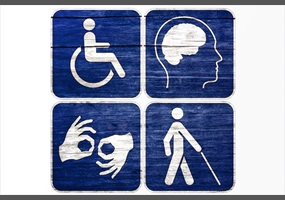
    Why is the wheelchair the only emblem used to represent disability?

    How does this approach disable you?

    Disability is seen as a social construct not a medical one. We’re vulnerable to people’s perceptions, mindsets, assumptions, behaviours, attitudes, views, prejudices, labels, stereotypes, and opinions.

    Disabled people aren’t seen as equal. We’re seen as inferior. Our limitations are amplified over our voices.

    Disability Reframed vs. Disability Debunked

    Disability Debunked is about dismantling stereotypes surrounding the disabled and look at our world through a disability lens.

    For example, DEBUNK DISABILITY: ADA30. Stop the messaging that individuals are broken, in need of healing, not whole, or sick.

    Disability Reframed is a need for societal re-education on disability. It combines self-learning with open dialogue and conversation to create a space where decades-old attitudes towards disability, disabled lives, and disabled people are dismantled, examined, and then thoughtfully rebuilt. In other words, we are redefining disability.

    Disability discrimination occurs when an employer or other entity covered by the Americans with Disabilities Act, as amended, or the Rehabilitation Act, as amended, treats a qualified individual with a disability who is an employee or applicant unfavourably because she has a disability. Disability discrimination also occurs if an employer fails to provide reasonable accommodations to job applicants and employees who need them to apply for a job, do a job, or enjoy equal benefits and privileges of employment, unless doing so would cause significant difficulty or expense for the employer; when an employer discriminates against an employee due to an association with an individual with a disability; and when an employer harasses or fails to stop the harassment of an employee on the basis of a disability.

    The development of disability discrimination laws signified the adoption of a public policy committed to the removal of a broad range of impediments to the integration of people with disabilities into society. This is what disables you!

    https://www.facebook.com/disabilitydebunked

    https://www.disabilityreframed.com/

    https://shadesofnoir.org.uk/journals/content/understanding-disability-impairment-conditions-and-diseases

    https://anti-bullyingalliance.org.uk/tools-information/all-about-bullying/responding-bullying/social-model-approach

    https://www.eeoc.gov/ada30-americans-disabilities-act-1990-2020

  • Disability Representation

    Disability Representation

    Disability has a negative connotation that extends beyond its definition, which includes impairments, activity limits, and participation restrictions. Disabled people’s attitudes and the degree of social exclusion they experience are manifested in actions that vary greatly depending on the kind of impairment and various social, community, and familial factors. The impact of an individual’s position, as well as the type and degree of his or her handicap, and, in particular, his or her gender, can be tremendous.

    People with Disabilities have been fighting for their right to be heard, both in their own lives, as well as in the greater community. This fight continues to this day, and I want to bring their voices and needs to the forefront. Having direct input in one’s life has a clear effect on overall health, well-being, and quality of life.

    People don’t come with labels.

    ‘You don’t look ill’! Just because you can’t see it doesn’t mean it isn’t there. A diagnosis should never define anyone.

    The skills of handicapped individuals are generally undervalued in society.

    Why is the wheelchair the only emblem used to represent disability?

    This gives a distorted view of disability. We need self respect and mutual respect.

    Wheelchair Privilege

    It is hard to acknowledge our own privilege because privilege is the other side of oppression. Some people are against talking about privilege because they don’t want to be framed as the aggressors or complicit in a system that gives them an advantage at the expense of others. Other critics of the word ‘privilege’ mistake it for a blanket term that suggests that, if you have a privilege, your whole life has been easy.

    Ultimately, privilege is not a concept designed to make people feel guilty or to diminish their achievements. Instead, waking up to how you may have certain privileges is an essential first step towards being able to decisively act, in small and large ways, to use your privilege and make the systems we were born into fairer. One example of this is wheelchair privilege.

    For example, some taxis are only equipped for manual wheelchairs, not electric ones. The physically impaired may be entitled to more benefits than any other disability group.

    In order to use your own privilege for good and to be a good ally you have to be aware, listen and speak up. Focus on equity instead of equality so that everyone is given what they need to be successful. https://www.hivelearning.com/site/resource/diversity-inclusion/5-main-types-of-privileges/

    What about the speech impaired?

    Just because you can’t speak doesn’t mean you don’t have anything to say. The Purple Vote Campaign in Wales is good at doing this. Advocating for yourself is important. Speak with me, not for me!

    Freedom of speech

    Article 21 – Freedom of expression and opinion, and access to information

    People with disabilities should be able to exercise the same rights to freedom of expression and information as other people and through all forms of communication of their choice. The UN Convention on the Rights of Persons with Disabilities (CRPD) also protects freedom of expression and the right to information. https://www.article19.org/resources/disability-and-information-what-are-your-rights/#:~:text=People%20with%20disabilities%20should%20be,and%20the%20right%20to%20information..

    States Parties shall take all appropriate measures to ensure that persons with disabilities can exercise the right to freedom of expression and opinion, including the freedom to seek, receive and impart information and ideas on an equal basis with others and through all forms of communication of their choice, as defined in article 2 of the present Convention, including by:

    a) Providing information intended for the general public to persons with disabilities in accessible formats and technologies appropriate to different kinds of disabilities in a timely manner and without additional cost;

    b) Accepting and facilitating the use of sign languages, Braille, augmentative and alternative communication, and all other accessible means, modes and formats of communication of their choice by persons with disabilities in official interactions;

    c) Urging private entities that provide services to the general public, including through the Internet, to provide information and services in accessible and usable formats for persons with disabilities;

    d) Encouraging the mass media, including providers of information through the Internet, to make their services accessible to persons with disabilities;

    e) Recognizing and promoting the use of sign languages. https://www.un.org/development/desa/disabilities/convention-on-the-rights-of-persons-with-disabilities/article-21-freedom-of-expression-and-opinion-and-access-to-information.html.

    The colour purple is used to represent the disabled community because it means royalty, status and importance.

    Purple Tuesday and the Purple Pound are business initiatives to improve customer service for people with disabilities.

    Paralympic Games is a global sports competition for people with disabilities. It is a modified version of the Olympics for people with disabilities. Highlighting abilities and maximising potential.

    International Day of People with Disabilities showcases wheelchair access, history of disability in education, disabled icons, disabled political figures and celebrates diversity. Celebrated on 3rd December every year, the International Day of Persons with Disabilities aims to promote an understanding of disability issues and to mobilise support for the dignity, rights, and well-being of persons with disabilities. Each year the day focuses on a different issue.

    Advocacy

    Advocacy includes speaking up on other people’s behalf. This could also cover unemployment amongst people with disabilities.

    ‘Disability equals diversity not disadvantage.’

    We should be accepted without having to ‘fit in’.


    Tips for Advocacy

    • Be Persistent
    • Build Effective Coalitions

    Self-Advocacy Skills

    • Be assertive vs Aggressive
    • Be direct
    • Be intentional
    • Be accurate
    • Healthcare
    • Relocating
    • Emotional Needs- Social Isolation

    Advocacy usually includes petitions, protests, lobbying, placards, propaganda, elections, party politics, and pressure groups. Being an advocate makes you an agent of change.

    The importance of rejecting society’s toxic value system

    It’s about dignity. This is important especially when fighting microaggressions. https://www.bustle.com/articles/186060-13-microaggressions-people-with-disabilities-face-on-a-daily-basis.

    At the heart of it, representation matters because people matter. Disabled persons exist in every nation and community across the world. It is essential that we respect human rights for all humans no matter their abilities or disabilities.