Tag: the view from where i sit versus the view from where you sit

  • Julius Arnold

    Julius Arnold (1835-1915) was a German pathologist.

    His name is affiliated with Type II Chiari malformation (Arnold–Chiari malformation).

    With a primary interest in pathology and anatomy, Arnold made contributions in a number of areas, including the anatomy associated with gunshot wounds (1870).

    Biography
    Born 19 August 1835 Zurich, Germany
    Son to German anatomist Freidrich Arnold (1803-1890)
    Studied under Rudolf Virchow and Nikolaus Freidrich in Heidelberg
    Later became Professor of Anatomy at Heidelberg
    Died 3 February 1915


    Medical associations
    Arnold–Chiari malformation (1894) – Type II Chiari malformation associated with myelomeningocele
    Friedrich-Erb-Arnold syndrome [aka Uehlinger syndrome; Pachydermoperiostosis or primary hypertropic osteoarthropathy] Characterized by pachydermia (thickening of the facial skin and/or scalp); digital clubbing; and periostosis (swelling of periarticular tissue).


    Key Medical Attributions:
    In 1894 Arnold described his pathological post-mortem findings of an infant with herniation of the cerebellar tonsils and 4th ventricle through the foramen magnum. The infant also had spina bifida. The similarities between this and the findings of Hans Chiari lead to this being named the ‘Arnold-Chiari Malformation‘. Alternatively known as Chiari malformation II.
    The findings Chiari had previously described involved brainstem herniation with associated spina bifida. However, the infant in that case had associated hydrocephalus, which was not the case with Arnold’s findings.

    https://en.wikipedia.org/wiki/Julius_Arnold

    https://litfl.com/julius-arnold/

  • Hans Chiari

    Hans Chiari (1851-1916) was an Austrian pathologist. He is named after and affiliated with the Chiari malformations; Type II Chiari malformation (Arnold–Chiari malformation) and Budd–Chiari syndrome (1899).

    Biography
    Born November 4, 1851 in Vienna, Austria
    Studied medicine in Vienna and worked as an assistant at the Vienna Institute of Pathology under Karl Rokitansky (1804–1878)
    1875 – Graduated medical school from the Unviersity of Vienna
    1878 – Habilitated in pathological anatomy in Vienna
    1882 – Professor extraordinarius of pathology at the German University in Prague
    1883 – Appointed professor ordinarius and superintendent of the pathological-anatomical museum in Prague
    1906 – Commenced as professor ordinarius at the University of Strasbourg
    Died May 6, 1916 in Strasbourg following a throat infection

    Hans Chiari published a case series of three patients with hepatic vein thrombosis, and a literature review of seven additional patients. He named the disease ‘phlebitis obliterans‘, and postulated that the thrombosis was a complication of endo-phlebitis likely from syphilis. Lange postulated an inflammatory process in hepatic vein thrombosis prior, in 1886.

    Chiari published across a wide range of pathology, including malformations of the brainstem and cerebellum, hepatic vein thrombosis, aortooesophageal fistula, choriocarcinoma, carotid artery plaques and thrombosis, autodigestion of the pancreas, and connections between the eustachian and thebesian heart valves.

    Pathology of showed congested and necrotic livers, porto-mesenteric circulation congestion, large volume ascites, and minimal adventitial reaction without perivascular involvement on histology. Chiari provided the first clinical and pathological correlations of this syndrome.

    Chiari malformations – abnormalities of the brain stem and cerebellum identified by Chiari on post-mortems. Type 1 (1891) – peg-like elongation of the cerebellar tonsils into the spinal canal through the foramen magnum; Type 2 aka Arnold Chiari malformation and Type 3 and 4.

    Chiari network – mobile net-like connections between the valve of the coronary sinus and the valve of the inferior vena cava. An anatomical variant, usually of no clinical significance.

    https://litfl.com/hans-chiari/

  • Fanny J. Crosby, a renowned American hymn writer played a significant role in the realm of disability history.

    Born on March 24, 1820, in Putnam County, New York, Fanny lost her sight when she was only six weeks old. Yet, she did not allow this disability to dampen her spirit or ambition.

    Crosby’s contribution to American hymnology is immense, with over 8,000 hymns attributed to her name. Despite her blindness, she became the most prolific hymn writer in history, penning classic favorites such as “Blessed Assurance,” “Pass Me Not, O Gentle Savior,” and one of my personal favorites “To God Be the Glory.”

    Apart from her musical prowess, Fanny Crosby was an active advocate for people with disabilities. She supported efforts to improve education and opportunities for those who were visually impaired.

    Attending the New York Institution for the Blind as a student, she later returned as a teacher and was deeply involved in advocating for the rights and education of visually impaired individuals.

    Crosby engaged in social causes, often speaking and organizing support for various charities aimed at alleviating the struggles of the disabled.

    Fanny J. Crosby’s legacy is a testament to resilience and faith.

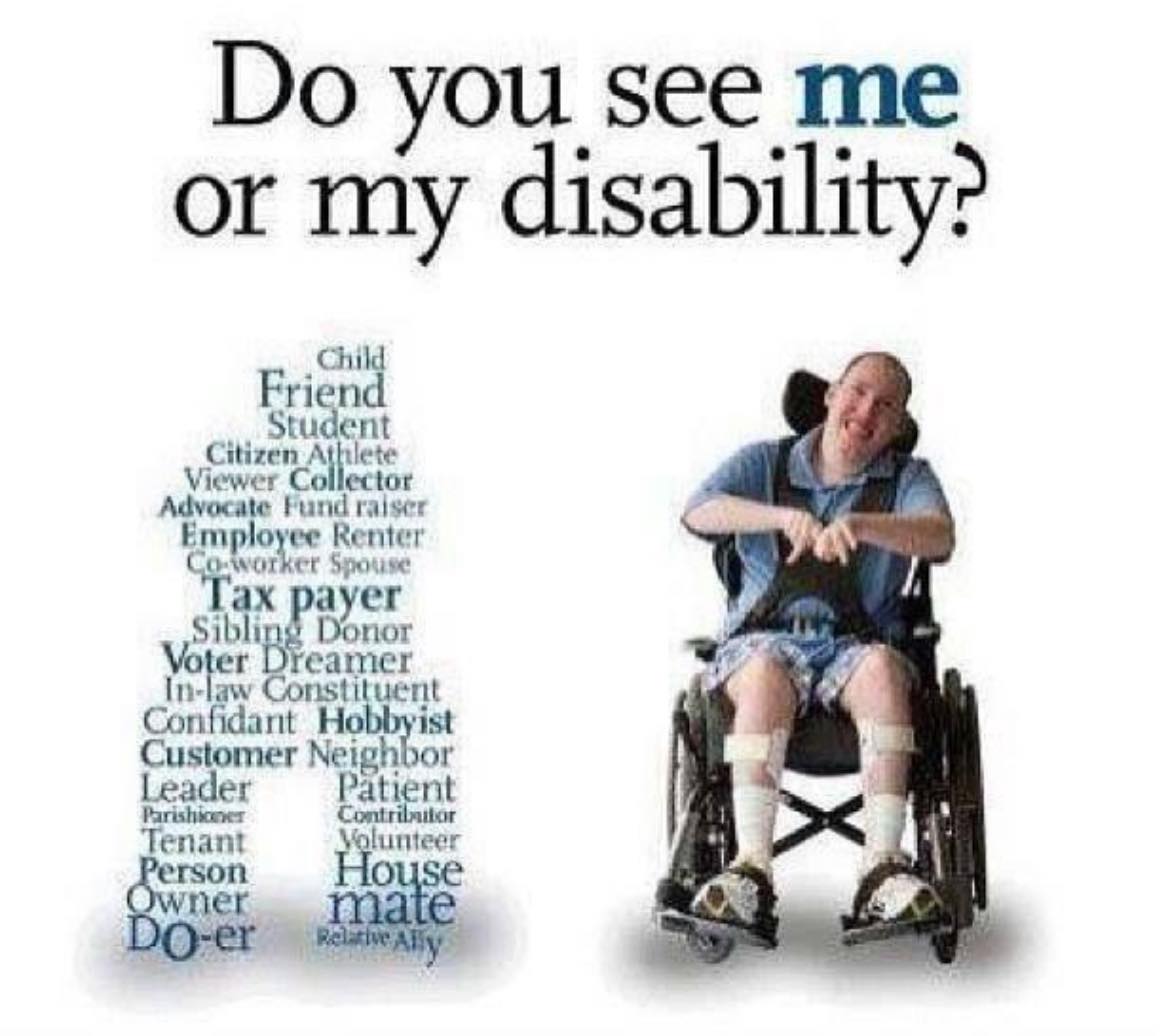
  • Do You See Me?

    Do You See Me?

    Do you see me or my disability?

    See me first! Not my wheelchair.

    Look past my failures and faults.

    Look past my frailties.

    Look past my sickness.

    Look past my disability.

    Look past my wheelchair.

    There’s more to me than what you see.

  • Swimming for People with Special Needs

    Walking onto the beach, feeling the sand between your toes and as you step into the ocean you can see your feet through the clear blue water. What a wonderful experience for many, but for some of us who can’t walk, going to the beach may not be such a joyous occasion.

    First of all when it comes to accessibility, there are the barriers to get into the beach and in order for a wheelchair to get through it takes two or three people to lift it over.

    Also, sometimes because of various disabilities, some of us have no sensation in our feet, the waist down or even the neck down. So consequently, we don’t have the luxury of feeling the sand between our toes or the ocean on our feet, which makes it even harder to enjoy.

    But aside from that, there are many swimming tools that we can use to enhance our swimming experience like rubber rings, life jackets, and other devices. There are also beach chairs available for wheelchair users to sit in while in the water.

    One summer I worked as a junior counselor at an inclusive camp at Wind Reach Recreational Village. While working there, there was one little boy named Dylan who needed to use a trachea and I remember when the camp had Water Day every Friday he was not able to participate with everyone else because if he got his trachea wet it would be harmful to him.

    There was also a girl there who had a problem where she had to be constantly monitored in the water and all counselors had to make sure that she didn’t fall asleep because if she did she could end up having a seizure in her sleep which is life threatening for her. Working at the camp was such an eye opener to the vast range of disabilities that are in Bermuda.

  • Territories Talk!

    Territories Talk!

    Territories Talk is a unique online forum with host from around the Overseas Territories, discussing social, economic and political issues pertinent to the people of the Overseas Territories. Today we will be speaking with Daniella Jade Lowe about life in the UK and her advocacy on several issues.

    Feel free to watch the video below:

    https://www.youtube.com/live/dWXc9ucgV4Uhttps://www.youtube.com/live/dWXc9ucgV4U.

  • Bills and Benefits

    Money problems always arise while unemployed. You need a job to get work experience and you need work experience to get a job. It doesn’t make sense. Financial plans and budgeting can help you manage your money especially when in debt.

    If you are a wheelchair user facing court, The Skipton County Court is wheelchair accessible for wheelchair users. If you fall into debt while jobless and jobseeking, you can apply for benefits like:

    • Jobseekers Allowance- they help you apply for jobs too.
    • Universal Credit- you also receive assistance in applying for jobs.
    • Council Tax Reduction
    • Housing Benefit and housing advice from Horton Housing
    • Personal Independence Payment

    Organisations that give debt cancellation and Legal Advice

    • National Debtline
    • Citizens Advice Bureau
    • GOV.UK
    • Money Advice Service
    • Turn 2 Us
    • Civil Legal Aid
    • Community Legal Service Fund
    • Shelter

    These organisations can be contacted if you struggle with rent arrears or run the risk of eviction. Many folks think taking out a loan automatically tarnishes your creditworthiness. This isn’t necessarily true. If managed properly, having a loan can actually Improve Your Credit History. By showing that you can responsibly pay off debt, you’re proving to lenders that you’re a safe bet.

    https://www.bing.com/ck/a?!&&p=1d00c4ad539dad18b68ea5b991db7212f3dd345eba71a0ee9f86c2cc3b88f509JmltdHM9MTczNjAzNTIwMA&ptn=3&ver=2&hsh=4&fclid=30a9b117-ac51-6ec2-2315-a595ad9a6fc2&psq=does+taking+out+a+loan+help+pay+debts+or+make+it+worse%3f&u=a1aHR0cHM6Ly93d3cubW9ydGdhZ2Vjb25uZWN0b3IuY28udWsvYmxvZy9kb2VzLXRha2luZy1vdXQtYS1sb2FuLWxvb2stYmFkIzp-OnRleHQ9TWFueSUyMGZvbGtzJTIwdGhpbmslMjB0YWtpbmclMjBvdXQlMjBhJTIwbG9hbiUyMGF1dG9tYXRpY2FsbHkscHJvdmluZyUyMHRvJTIwbGVuZGVycyUyMHRoYXQlMjB5b3UlMjdyZSUyMGElMjBzYWZlJTIwYmV0Lg&ntb=1

    https://purposefulplanning.co.uk/product/budget-planner-notebook/

    https://www.lloydsbank.com/legal/financial-services-compensation-scheme.html

    https://www.gov.uk/universal-credit/how-to-claim

    https://news.sky.com/story/cost-of-living-payment-households-to-start-receiving-second-grant-ahead-of-winter-12996979

    https://www.hft.org.uk/benefits-and-support/pips/

  • The Highway Code

    I just recently found out that it is illegal for wheelchair users to roam the streets without lights.

    The Highway Code is a set of information, advice, guides and mandatory rules for road users in the United Kingdom. Its objective is to promote road safety and applies to all road users including pedestrians, horse riders and cyclists, as well as motorcyclists and drivers. It gives information on road signs, road markings, vehicle markings, and road safety. The Highway Code is essential reading for everyone and aims to promote safety on the road, whilst also supporting a healthy, sustainable and efficient transport system.

    I knew that it was unsafe but I didn’t realise it was illegal. How can it be illegal if wheelchairs are not licensed vehicles? What if wheelchair users don’t have access to lights? What if they are expensive and unaffordable?

    Lights or reflectors can be purchased online through Amazon. They can also be found at any cycling store. So now that we know, let’s abide by the rules!

    https://www.highwaycodeuk.co.uk/

  • Who decides when I die?

    ASSISTED DYING BILL 2024 UK

    I am against this assisted dying . It’s legalised murder. I am completely behind Tani Grey Thompson and her views. Life is to be valued. The Bill is ungodly.

    Murder, in criminal law, is defined as the killing of one person by another that is not legally justified or excusable, usually distinguished from the crime of manslaughter by the element of malice premeditated.

    The penalty for illegal murder is capital punishment.

    Euthanasia

    Euthanasia means “a gentle and easy death.” Not a painful and screaming death.
    What is the reality in hospitals?
    • Doctors offer support systems to help patients live as active as possible until death.
    • Most doctors carry out euthanasia yet still don’t do anything for it to be legalized.

    Voluntary euthanasia sometimes called assisted suicide is where the patients have made it clear that he/she wishes to die and requests help to bring this about. There are many alternative approaches and options.

    For example:
    • People refusing medical treatment even if that treatment is required to save their life.
    • Advanced decision such as stopping the life support machine.
    • The patients refuse the attempting of resuscitation orders (CPR).

    Arguments For
    • The right of the individual to choose should be paramount. So long as the patient is articulate, and his or her intent is clear beyond doubt, there need be no further questions.
    • Many people think that each person has the right to control his or her body and life and so should be able to determine at what time, in what way and by whose hand he or she will die.
    • Human beings should be as free as possible. Unnecessary restraints on human rights are a bad thing.
    • Human beings are independent biological entities, with the right to take and carry out decisions about themselves, providing the greater good of society doesn’t prohibit this. Related to this is a firm belief that death is the end.
    • The right to life is not a right simply to exist.
    • The right to life is a right to life with minimum quality and value.

    • Death is the opposite of life, but the process of dying is part of life.
    • Dying is one of the most important events in human life.
    • Dying can be good or bad.
    • People have the right to try and make the events in their lives as good as possible, so they have the right to try to make their dying as good as possible.
    • If the dying process is hostile, people should have the right to shorten it, and reduce the excruciating discomfort.
    • If an animal had a life threatening illness, the vet thinks the kindest way to treat the animal would be to put it to sleep. Therefore if Euthanasia happens with animals then it should happen with humans too.
    • Six out of ten adults (60%) would only want comfort care at the end of their lives, although just 3% had made their treatment wishes clear in an advanced decision.
    • Fewer than two in ten people (14%) would want medical intervention- with less than one in ten (8%) people wanting full medical intervention at the end of life.
    • A survey found that a large majority (75%) of the British population think that legislation on Euthanasia should be amended to allow some degree of assisted suicide. Just over two thirds (67%) think that doctors in particular should have the legal power to end the life of a terminally ill patient who has personally given a clear indication of wanting to die.
    • This argument goes that since euthanasia will continue to take place, even though it’s illegal, it would surely be better to make it legal and regulate it to minimize abuse.
    • A Medix survey in the UK in 2004 found that 45% of doctors understood that their colleagues actively helped their patients die.
    • Vulnerable patients might be better protected than they are at present if there were set procedures and rules that had to be followed for euthanasia.
    • A patient who feared that they were under pressure to decide in favour of euthanasia would be able to gain help and support by initiating the formal procedures involved in regulated euthanasia – something that they cannot do now.
    • People have an explicit right to die.
    • A separate right to die is not necessary, because our other human rights imply the right to die
    • Death is a private matter and if there is no harm to others, the state and other people have no right to interfere
    • It is possible to regulate euthanasia.
    • Allowing people to die may free up scarce health resources.
    • Euthanasia happens anyway.
    • Euthanasia satisfies the standard that moral rules must be universal.
    • Euthanasia happens anyway.
    • Is death a bad thing?

    Arguments Against
    • Euthanasia would not only be for people who are “terminally ill.”
    • Euthanasia can become a means of health care cost containment.
    • Euthanasia will become non-voluntary.
    • Euthanasia is a rejection of the importance and value of human life.
    Dignity in Dying is a campaign that supports Euthanasia. They also have famous patrons who share their views of supporting this campaign. These patrons include Jo Brand who is a comedian, Sir Patrick Stewart who is a famous British actor.

    • Euthanasia has already been legalised in these countries:

    Oregon- 2001

    Belgium- May 2002

    Luxembourg- February 2008

    The Netherlands- 2002

    This bill contradicts the Equality Act 2010, which gives everyone the right to life. It’s all about affirming and defending human dignity, and the right to life of every human being.

    Hi, MPs voted on 29 November on an extreme Bill that, if successful, will introduce a dangerous assisted suicide law. This Bill is being rushed through Parliament. It was only published at 10pm on 11 November, giving MPs and the public barely two and half weeks to scrutinise the Bill before it goes to a vote. It’s vital that MPs hear from us now, showing that there are many who oppose this extreme and harmful change from being rushed into law – a change that would put countless vulnerable lives at risk. You can help stop this from happening by contacting your MP now using this simple tool: https://righttolife.org.uk/9ly4.

    I just emailed my MP, and it took less than 30 seconds!

    Please make sure to share with a friend after emailing your MP – every share is crucial to help us defeat this Bill.

    https://www.bbc.co.uk/news/articles/cx2l7m6r55do

    https://righttolife.org.uk/

    http://www.dignityindying.org.uk/assited-dying.html.

    https://www.independent.co.uk/voices/assisted-dying-bill-law-passed-mps-tanni-grey-thompson-b2656170.html?fbclid=IwY2xjawG4IglleHRuA2FlbQIxMQABHfpn6mIPKMva9cCa21z2w20Mm-nSiaOVg3P2wFYGhyoGX_gLvAP8gyb5Pg_aem_zRNkQNJ1C1NsVh5U4JuBoQ

    https://www.britannica.com/topic/murder-crime

  • What are the Web Content Accessibility Guidelines?

    Ever since I’ve embarked on my journey to marketing myself as an Access Consultant, I’ve had an increasing interest in legislation surrounding Access Consultancy. I believe my BA Degree in History and Politics has sparked this interest.

    Before then, I had never heard of Access Consultancy.

    Are WCAG guidelines law?
    Whilst the WCAG standards themselves do not function as law, they represent the internationally recognised standard for web content accessibility, and you will meet the legal requirements for accessibility by meeting the WCAG standard.

    Who is required to comply with WCAG?
    Ensuring your website is accessible is covered by the Equality Act 2010 in the UK, which protects all individuals from unfair treatment and promotes a fair and more equal society.

    There are equivalent laws in other countries, which encompass web accessibility law and legislation, such as the Americans with Disabilities Act (ADA) of 1990. The European Accessibility Act (EAA) seeks to ensure equal access to digital products and services throughout Europe and becomes law in all EU member states in June 2025.

    The Public Sector Bodies (Website and Mobile Applications) Accessibility Regulations (PSBAR 2018) apply to the UK public sector specifically and require public sector organisations to meet WCAG 2.2 guidelines at AA level of conformance, which from October 2024 will be monitored by the Government Digital Service (GDS).

    What happens if your website is not accessible?
    Not ignoring the threat of legal action, it’s very important to consider the barriers you might be creating for people if you are not ensuring your web content is accessible.

    There are an estimated 16 million disabled people in the UK, and in 2019 the ‘Click-Away Pound’, which measures the volume of people who abandon a retail website because of the barriers they found, grew to £17.1 billion.

    Good accessibility practices benefit everyone, not just disabled people. Consider a person using captions when watching a video on a noisy train, or a worker with a sprained wrist using speech-to-text to write an email. Many of us use accessibility features every day.

    The free guide to the Business Case for Accessibility will help you win hearts and minds inside and outside your organisation.


    To find out more about WCAG and digital accessibility join their mailing list or take a look at their free digital accessibility resources. If you’re ready to create meaningful change and achieve significant results, speak to their experts to learn how they can help you to achieve your accessibility goals.