Tag: opinions

  • Understanding what disables people

    The definition of disability under the Equality Act 2010 is absolute (and protects an individual from discrimination) if you have a physical or mental impairment that has a ‘substantial’ and ‘long-term’ negative effect on your ability to do general daily activities.

    The UK’s failure to incorporate the UNCRPD into domestic law, reinforces the regressive medical model of disability. Due to the dualist nature of the British Constitution, and since the Convention has not been enacted into domestic law by an Act of Parliament, disabled claimants cannot rely on it in the British Courts. Therefore, disabled people must rely on the UK’s anti-discrimination legislation, such as the Equality Act 2010, before attempting to convince courts to use the CRPD in interpreting relevant key concepts.

    The Social Approach to Disability

    The Social Approach to Disability includes people’s views, opinions and attitudes. It has been the prominent approach to disability over the last 30+ years.

    It was developed by disabled people based on real life experience of discrimination, inclusion and challenging disabling barriers. It is outward looking and focused on the things in society that can be changed or improved, like, the environment, information, communications and people’s attitudes.

    It’s a problem solving approach which gives disabled people greater control over vital, even basic decisions, like, from what time to get out of bed on a morning to employability and education choices.

    This approach enables you to better understand how reasonable adjustments can be implemented. It also focuses on the things you can influence or change and promotes valued skills.

    Why is the wheelchair the only emblem used to represent disability?

    How does this approach disable you?

    Disability is seen as a social construct not a medical one. We’re vulnerable to people’s perceptions, mindsets, assumptions, behaviours, attitudes, views, prejudices, labels, stereotypes, and opinions.

    Disabled people aren’t seen as equal. We’re seen as inferior. Our limitations are amplified over our voices.

    Disability Reframed vs. Disability Debunked

    Disability Debunked is about dismantling stereotypes surrounding the disabled and look at our world through a disability lens.

    For example, DEBUNK DISABILITY: ADA30. Stop the messaging that individuals are broken, in need of healing, not whole, or sick.

    Disability Reframed is a need for societal re-education on disability. It combines self-learning with open dialogue and conversation to create a space where decades-old attitudes towards disability, disabled lives, and disabled people are dismantled, examined, and then thoughtfully rebuilt. In other words, we are redefining disability.

    Disability discrimination occurs when an employer or other entity covered by the Americans with Disabilities Act, as amended, or the Rehabilitation Act, as amended, treats a qualified individual with a disability who is an employee or applicant unfavourably because she has a disability. Disability discrimination also occurs if an employer fails to provide reasonable accommodations to job applicants and employees who need them to apply for a job, do a job, or enjoy equal benefits and privileges of employment, unless doing so would cause significant difficulty or expense for the employer; when an employer discriminates against an employee due to an association with an individual with a disability; and when an employer harasses or fails to stop the harassment of an employee on the basis of a disability.

    The development of disability discrimination laws signified the adoption of a public policy committed to the removal of a broad range of impediments to the integration of people with disabilities into society. This is what disables you!

    https://www.facebook.com/disabilitydebunked

    https://www.disabilityreframed.com/

    https://shadesofnoir.org.uk/journals/content/understanding-disability-impairment-conditions-and-diseases

    https://anti-bullyingalliance.org.uk/tools-information/all-about-bullying/responding-bullying/social-model-approach

    https://www.eeoc.gov/ada30-americans-disabilities-act-1990-2020
  • Disability Representation

    Disability Representation

    Disability has a negative connotation that extends beyond its definition, which includes impairments, activity limits, and participation restrictions. Disabled people’s attitudes and the degree of social exclusion they experience are manifested in actions that vary greatly depending on the kind of impairment and various social, community, and familial factors. The impact of an individual’s position, as well as the type and degree of his or her handicap, and, in particular, his or her gender, can be tremendous.

    People with Disabilities have been fighting for their right to be heard, both in their own lives, as well as in the greater community. This fight continues to this day, and I want to bring their voices and needs to the forefront. Having direct input in one’s life has a clear effect on overall health, well-being, and quality of life.

    People don’t come with labels.

    ‘You don’t look ill’! Just because you can’t see it doesn’t mean it isn’t there. A diagnosis should never define anyone.

    The skills of handicapped individuals are generally undervalued in society.

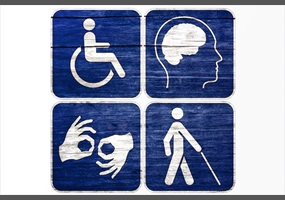
    Why is the wheelchair the only emblem used to represent disability?

    This gives a distorted view of disability. We need self respect and mutual respect.

    Wheelchair Privilege

    It is hard to acknowledge our own privilege because privilege is the other side of oppression. Some people are against talking about privilege because they don’t want to be framed as the aggressors or complicit in a system that gives them an advantage at the expense of others. Other critics of the word ‘privilege’ mistake it for a blanket term that suggests that, if you have a privilege, your whole life has been easy.

    Ultimately, privilege is not a concept designed to make people feel guilty or to diminish their achievements. Instead, waking up to how you may have certain privileges is an essential first step towards being able to decisively act, in small and large ways, to use your privilege and make the systems we were born into fairer. One example of this is wheelchair privilege.

    For example, some taxis are only equipped for manual wheelchairs, not electric ones. The physically impaired may be entitled to more benefits than any other disability group.

    In order to use your own privilege for good and to be a good ally you have to be aware, listen and speak up. Focus on equity instead of equality so that everyone is given what they need to be successful. https://www.hivelearning.com/site/resource/diversity-inclusion/5-main-types-of-privileges/

    What about the speech impaired?

    Just because you can’t speak doesn’t mean you don’t have anything to say. The Purple Vote Campaign in Wales is good at doing this. Advocating for yourself is important. Speak with me, not for me!

    Freedom of speech

    Article 21 – Freedom of expression and opinion, and access to information

    People with disabilities should be able to exercise the same rights to freedom of expression and information as other people and through all forms of communication of their choice. The UN Convention on the Rights of Persons with Disabilities (CRPD) also protects freedom of expression and the right to information. https://www.article19.org/resources/disability-and-information-what-are-your-rights/#:~:text=People%20with%20disabilities%20should%20be,and%20the%20right%20to%20information..

    States Parties shall take all appropriate measures to ensure that persons with disabilities can exercise the right to freedom of expression and opinion, including the freedom to seek, receive and impart information and ideas on an equal basis with others and through all forms of communication of their choice, as defined in article 2 of the present Convention, including by:

    a) Providing information intended for the general public to persons with disabilities in accessible formats and technologies appropriate to different kinds of disabilities in a timely manner and without additional cost;

    b) Accepting and facilitating the use of sign languages, Braille, augmentative and alternative communication, and all other accessible means, modes and formats of communication of their choice by persons with disabilities in official interactions;

    c) Urging private entities that provide services to the general public, including through the Internet, to provide information and services in accessible and usable formats for persons with disabilities;

    d) Encouraging the mass media, including providers of information through the Internet, to make their services accessible to persons with disabilities;

    e) Recognizing and promoting the use of sign languages. https://www.un.org/development/desa/disabilities/convention-on-the-rights-of-persons-with-disabilities/article-21-freedom-of-expression-and-opinion-and-access-to-information.html.

    The colour purple is used to represent the disabled community because it means royalty, status and importance.

    Purple Tuesday and the Purple Pound are business initiatives to improve customer service for people with disabilities.

    Paralympic Games is a global sports competition for people with disabilities. It is a modified version of the Olympics for people with disabilities. Highlighting abilities and maximising potential.

    International Day of People with Disabilities showcases wheelchair access, history of disability in education, disabled icons, disabled political figures and celebrates diversity. Celebrated on 3rd December every year, the International Day of Persons with Disabilities aims to promote an understanding of disability issues and to mobilise support for the dignity, rights, and well-being of persons with disabilities. Each year the day focuses on a different issue.

    Advocacy

    Advocacy includes speaking up on other people’s behalf. This could also cover unemployment amongst people with disabilities.

    ‘Disability equals diversity not disadvantage.’

    We should be accepted without having to ‘fit in’.


    Tips for Advocacy

    • Be Persistent
    • Build Effective Coalitions

    Self-Advocacy Skills

    • Be assertive vs Aggressive
    • Be direct
    • Be intentional
    • Be accurate
    • Healthcare
    • Relocating
    • Emotional Needs- Social Isolation

    Advocacy usually includes petitions, protests, lobbying, placards, propaganda, elections, party politics, and pressure groups. Being an advocate makes you an agent of change.

    The importance of rejecting society’s toxic value system

    It’s about dignity. This is important especially when fighting microaggressions. https://www.bustle.com/articles/186060-13-microaggressions-people-with-disabilities-face-on-a-daily-basis.

    At the heart of it, representation matters because people matter. Disabled persons exist in every nation and community across the world. It is essential that we respect human rights for all humans no matter their abilities or disabilities.

  • DANNY TURNS DOWN THE….

    DANNY TURNS DOWN THE….

    By: Daniella Jade Lowe

    Danny was a young Para-Superhero. Nobody had seen or even heard of a neurodiverse superhero. He had an adaptive costume for all occasions. His wheelchair was faster than the speed of lightning.

    Being born as a Para-Superhero, made Danny quite the ‘oddball.’ He was birthmarked to defy genetic dispositions. He demanded respect wherever he went.

    As a Para-Superhero he always wanted to prove people wrong which made him ambitious.

    ‘A superhero is supposed to save the day,’ he thought.

    ‘How can I save the day as a Para-Superhero?’ Danny thought to himself.

    Unfortunately he inherited the nickname, ‘supercrip.’

    As Danny got older he could not tolerate the stigma that came with being a Para-Superhero. Too many titles from society caused him to lose who he was. As a result, he suffered an ‘identity crisis.’

    Danny already dealt with physical limitations. He didn’t want people’s labels too. It brought intersectionality to his personality.

    The mainstream world saw Danny as ‘privileged’ but ‘abnormal’ when all he wanted was ‘acceptance’ which often led to discrimination.

    ‘What is normal?’ Danny would think to himself.

    ‘Normal is the setting on a dryer!’ he concluded.

    This one stereotype has repeated itself so much that it resounds like a broken record to Danny.

    His mother reminded him, ‘It’s not about what they call you, it’s what you answer to!’

    Stereotypes were his handicap. Danny had two options, either take life lying down or be motivated to live up to his own goals and expectations. So he started a war on stereotypes with archetypes.

    This war included fighting against exploitation of disabilities, deformities, misconceptions, and negative portrayal of disabilities. ‘Disability is not a taboo!’ he said. Inclusion is not a delusion.
    • Heroes don’t need to overcome their disabilities.
    • Wheelchairs aren’t exclusively for older people.
    • We are not “inspiration porn”.
    • Who said you need to walk in order to be a hero?
    ‘Let’s have a ‘big conversation’ on stereotypes,’ Danny exclaimed!
    ‘Stereotypes exist, definitely, but that’s why we should listen to the individual voices of disabled people over non-disabled charity voices’ Danny said!
    Danny says, ‘Let me tell you how to deal with the terrible power of stereotypes.’ ‘Disable the label!’ Assumptions are lazy. Statistics should not affect status.
    • Change the stereotypes. Challenge the ‘status quo.’ Upset the fruit basket. Walk a mile in someone else’s shoes.
    • Buffer the stereotype threat through shifting self perception to positive self affirmation.
    • Reframe the stereotype threatening task as a challenge. See a stereotype as a chance to prove people wrong instead of getting offended over it.
    • Reinterpret the anxiety that comes with stereotype threats. In other words, ‘don’t take it personal’ and make bold steps to overcome them.
    And that’s how Danny turned down the stereotypes!
  • Dealing with Disability in the Church: Third edition of series (Three Perspectives)

    Dealing with Disability in the Church: Third edition of series (Three Perspectives)

    By: Daniella Jade Lowe

    Dealing with Disability in the Church hasn’t been all that bad for me. First of all, I’d like to start out by saying, I’ve attended church all my life. I love church. I get involved in church services mainly by serving on the Audiovisual/Technical Team. I enjoy this.

    While living in Bradford I noticed that their churches have their own private buses to pick up and drop off their members.

    Now I’ve got one ‘bone to pick.’ Why are public buses in England expected to be wheelchair accessible but not private buses? Just an observation.

    However, whenever I asked to use it instead of taxis, I was told they do not take wheelchairs for liability reasons. Also I noticed the church I first attended, had a wheelchair section for easy access in case of a fire. I also attended a university campus church in Bradford.

    On the other hand, while living in Ilkley, there is one church that has a disability ministry for those with intellectual disabilities called the Ark, which meets the first Sunday of every month from 3pm to 6pm. Some other churches may even have Sign Language interpreters for the hearing impaired.

    In relation to handling disability, churches should take on The Good Samaritan Approach.

    Prayer

    I appreciate prayers. I have been asked to be prayed for and gladly accepted such. It can be slightly frustrating when your expectation for a change is so high and it doesn’t come which has discouraged me at times. But I do believe in miracles.

    However, I also know someone who has autism of a different persuasion. Her experiences in the church have almost never been positive. Many times, Christians have prayed for her to be healed of autism.

    She does not personally want to be “healed” of autism, because she believes that God intentionally allows some people to be born with autism or Down Syndrome for his own good reasons, and that these people are fearfully and wonderfully made in the image of God, and perfect just the way they are. They do not need to be healed; God made them like that.

    She feels that her autism is an integral part of who she is, and is not a negative thing, but rather a positive one. She does not feel that autism holds her back.

    When church people pray for her to be healed of autism, without asking her first whether she wants healing, or despite my objections to what they’re doing, that does not empower me. They are deciding on my behalf what direction they think my life should take, but they do not have that right; it’s my life. People with disabilities deserve to be in control of their own lives.

    Instead of being “healed,” all she wants is to be accepted by the church for the peculiar, wonderful, autistic person who she is. She needs acceptance and inclusion.

    When people pray for her to be healed of autism, she perceives them to be indirectly saying,

    “I want God to change you into a normal person, for my own comfort, because I can’t handle that we have a disabled person in our church. I don’t want to deal with having to include disabilities, so it’s easier if I can just try to heal them instead.”

    She fully believes that God does have the power to heal people. But she also believes that when church members wish to pray for a disabled person’s healing, they need to first ask that person whether he or she wants healing or not. If the disabled individual declines the offer, church members need to fully respect this, and not keep pushing healing on the person.

    It is good to be content and happy with life. I do agree to some extent. There is also a way of embracing disability without accepting it as if there’s no hope.

    In other words exhibit faith, despite the odds! Don’t glorify the problem, glorify the problem solver.

    Stating the facts about one’s medical condition isn’t necessarily claiming it but acknowledging that something is different about the way a person functions. We shouldn’t live in denial and shame, especially if people ask genuine questions out of curiosity.

    The Stigma around Medical Intervention

    Another subject I don’t understand is the notion that surgery or taking medicine isn’t faith. I believe God can heal through medical science. Sometimes medical intervention is part of the process. There is also nothing wrong with prayer and a psychologist, social worker or carers.

    Besides, faith without works is dead. I also notice that people tend to judge by appearances. I’m not looking for pity but inclusion.

    Wheelchair Accessibility: Functioning in Dysfunction

    Some churches in England have a health and safety policy where they have designated seating for the physically challenged. They’re also wheelchair accessible for the most part too.

    Wheelchair Accessibility and mobility issues are just some of the problems that the physically challenged face. Access alleviates the amount of limitations and restrictions on wheelchair users. Failing to ensure wheelchair accessibility is neglecting to provide reasonable adjustments. It is like functioning in dysfunction.

    I get really annoyed with drivers who park across dropped kerbs. Dropped kerbs are meant to make it easy for wheelchairs to enter and exit sidewalks. I think that drivers should either be fined or vehicles towed. Alternatively, if the church building isn’t wheelchair accessible, there is the option of watching services online, but then the problem with that is, one can’t mix and mingle with other believers. I suppose this will always be an issue depending on where one lives. There are many other issues that this subject can cover but this video should do the job. Why should your church be Disability Friendly?