Tag: disability awareness

  • Interview Techniques

    There are many ways to tackle an interview. Having an interview, is like taking an oral test. If you are confused about how to answer interview questions, these steps might help. These steps help to structure interview answers correctly.

    Interview Methods

    SMART

    Specific: Share details about your experience relevant to the role, your qualifications, and how your career path has led to this opportunity.
    Measurable: Quantify achievements or results when applicable (e.g., years of experience, promotions).
    Achievable: Highlight specific milestones you’ve reached.
    Relevant: Focus on skills and experiences that match the job description.
    Time-bound: Summarize your career journey, leading to the current moment.

    Behavioural Interview questions

    STAR

    Situation – the situation you had to deal with
    Task – the task you were given to do
    Action – the action you took
    Result – what happened as a result of your action and what you learned from the experience

    https://resumetrick.com/blog/smart-method.html

    https://youtube.com/shorts/pmMZFcXnxSg?si=RthhCrsMcAJW6b4E

  • Fanny J. Crosby, a renowned American hymn writer played a significant role in the realm of disability history.

    Born on March 24, 1820, in Putnam County, New York, Fanny lost her sight when she was only six weeks old. Yet, she did not allow this disability to dampen her spirit or ambition.

    Crosby’s contribution to American hymnology is immense, with over 8,000 hymns attributed to her name. Despite her blindness, she became the most prolific hymn writer in history, penning classic favorites such as “Blessed Assurance,” “Pass Me Not, O Gentle Savior,” and one of my personal favorites “To God Be the Glory.”

    Apart from her musical prowess, Fanny Crosby was an active advocate for people with disabilities. She supported efforts to improve education and opportunities for those who were visually impaired.

    Attending the New York Institution for the Blind as a student, she later returned as a teacher and was deeply involved in advocating for the rights and education of visually impaired individuals.

    Crosby engaged in social causes, often speaking and organizing support for various charities aimed at alleviating the struggles of the disabled.

    Fanny J. Crosby’s legacy is a testament to resilience and faith.

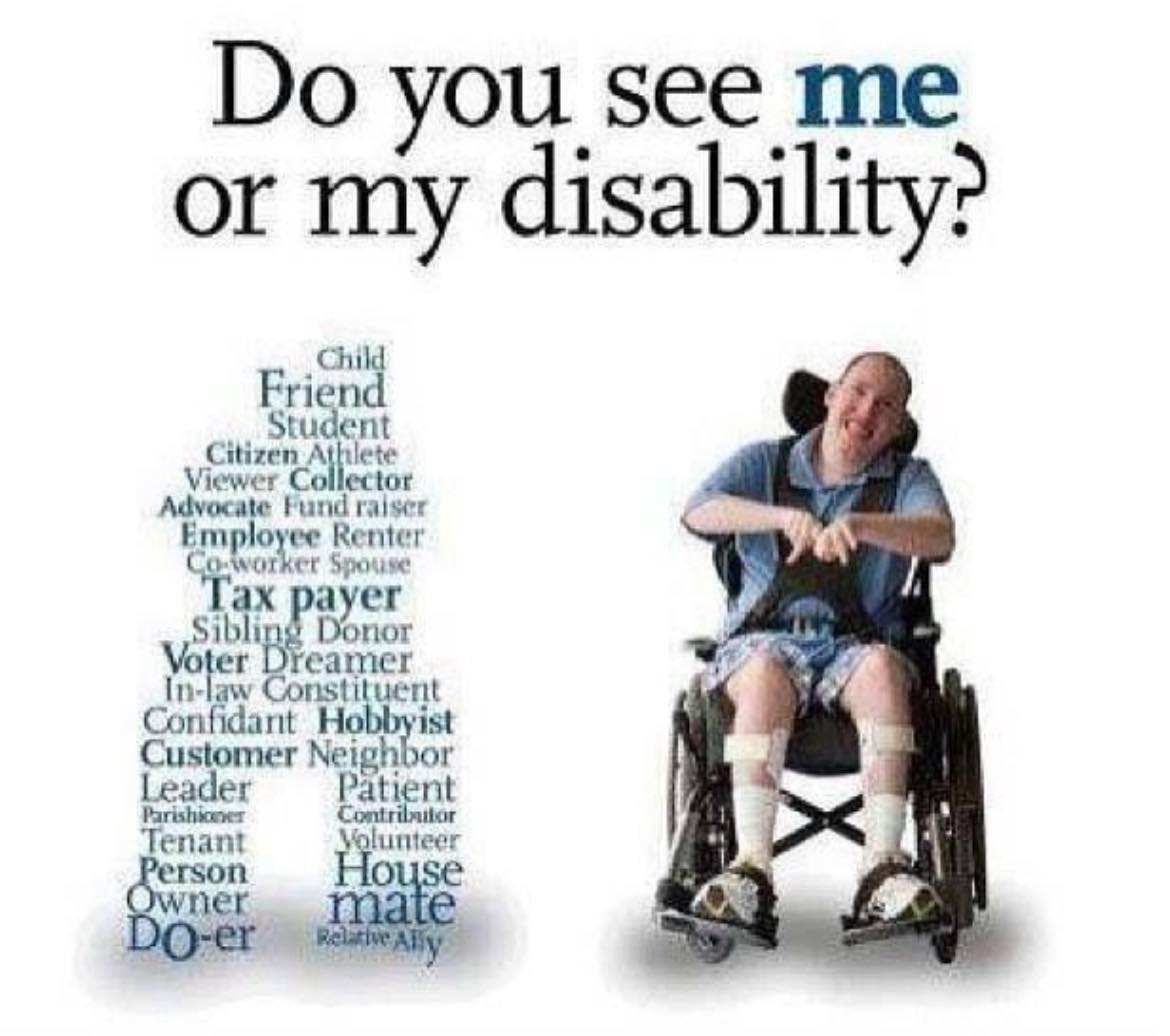
  • Do You See Me?

    Do You See Me?

    Do you see me or my disability?

    See me first! Not my wheelchair.

    Look past my failures and faults.

    Look past my frailties.

    Look past my sickness.

    Look past my disability.

    Look past my wheelchair.

    There’s more to me than what you see.

  • Changing the Narrative

    The religious model of disability.
    It doesn’t just belong to one faith. But it continues to do real harm across many.
    In Western contexts, Christianity has been especially influential, framing disabled people as cursed, sinful, or sent to “teach others” something. We’re turned into metaphors. Our lives become spiritual object lessons.


    But this model appears in other traditions too.


    In some interpretations of Islam, disability is seen as a test from Allah, a reason to be patient or a way to bring others closer to faith. Compassion is encouraged, but pity still lurks.


    In Hinduism, karma is sometimes used to explain disability as a consequence of past-life actions, fueling stigma and shame, even when combined with stories of divine difference.


    Buddhist views can also frame disability as a karmic result or a path toward detachment, encouraging compassion but still casting us as passive or burdensome.


    Judaism has both exclusionary laws and powerful teachings about justice and dignity, some texts limit full participation, but modern re-readings challenge that.


    Even in Indigenous and global faiths, disabled people might be seen as sacred in one context and shunned in another. Culture and theology shape how our bodies are read.
    So it’s not just about belief. It’s about power.


    When religion teaches that some bodies are purer, more sacred, or closer to enlightenment than others, it makes it easier to ignore injustice. It’s not enough to preach compassion while voting for cuts. Or pray for healing instead of fighting for access.


    But I respect the many people of faith who build real community, who fight inequality, and who welcome difference without trying to fix it. That solidarity matters.


    But we have to name the harm too.
    We don’t need to be healed.
    We need to be heard.

  • Learning Disability Week

    Learning Disability Week takes place annually during the third week of June. In 2025 Learning Disability Week starts on Monday June 16 June. The theme this year is ‘Do you see me?’, which is all about people with a learning disability being seen, heard and valued.

    This Learning Disability Week we are asking you to help us walk 1.5 million steps to help raise funds and awareness for the 1.5 million people in the UK with a learning disability.

    You’re welcome to join us anytime during our celebration! At 12pm, we meet at St. John’s Ben Rhydding Church for a picnic in the hall. Bring a packed lunch, drinks provided.

    The One Big Walk for Mencap starts at 1pm. it is a 1.5 mile walk into Ilkley. There is a suggested donation is £1.50 per person to Mencap.

    By 2:30pm, we meet at Outsisde the Box Cafe in Ilkley and bring some money to buy their delicious refreshments.The walk is wheelchair friendly but if walking is difficult, you can take the train from Ben Rhydding to Ilkley or book a taxi. If you need one to one support, please invite your carer to join you.

    Please wear comfortable shoes and clothing suitable for walking. Bring a packed lunch, money and any medication you need. There will be information tables at St. John’s and Outside the Box Cafe about local disability groups.

    Family, friends and carers are all welcome. We hope you enjoy it!

  • LEAN MANUFACTURING

    What is LEAN?

    Lean manufacturing is a methodology for maximizing customer value while minimizing waste in production. In practice, it means streamlining processes to only use the necessary resources and eliminate activities that don’t add value.

    USES and ORIGINS OF LEAN Manufacturing

    Lean’s origins trace back to the Toyota Production System (TPS) developed in Japan after WWII. Faced with resource shortages in the 1950s, Toyota engineers Taiichi Ohno and Eiji Toyoda pioneered a discipline of eliminating waste and continuously improving processes to do more with less. TPS introduced practices like just-in-time production and jidoka (built-in quality) which formed the foundation of Lean manufacturing.

    Productivity + Quality + Costs = Profitability

    PHILOSOPHY

    One of Lean Manufacturing’s foundations is Kaizen, which means continuous improvement. Kaizen is a management philosophy that involves the entire organization in improving processes, products, and services. It focuses on waste elimination and increasing value for the customer.

    Toyota 1950- Henry Ford started first

    1990s- the rest of the world followed

    Eight Types of Wastes

    • inventory
    • transportation
    • overproduction
    • overprocessing
    • underutilised people
    • scraps
    • efforts
    • movement

    LEAN Principles

    These five principles – Value, Value Stream, Flow, Pull, and Continuous Improvement – provide a high-level guide to implementing Lean. Next, we’ll dig into some specific tools and concepts (the “Lean toolbox”) that support these principles day-to-day.

    • value
    • value stream
    • flow
    • pull
    • perfection

    Benefits of LEAN

    • Increased efficiency: Streamlining processes to eliminate waste and improve productivity. 
    • Reduced costs: Lowering operational costs by minimizing waste and optimizing resources.
    • Improved product quality: Enhancing the quality of products through continuous improvement practices. 
    • Higher customer satisfaction: Delivering better value to customers by focusing on their needs and reducing lead times. 
    • Enhanced team engagement: Fostering a culture of continuous improvement and collaboration among team members.These benefits contribute to a more agile and responsive organization.

    Morale and Motivation improves

    PDCA Improvement Cycle (Deming)

    It’s often helpful to follow a structured model like PDCA (Plan-Do-Check-Act) for each change: plan the improvement, do it (on a small scale), check results, and act to standardize if successful. At this stage, you may be running multiple Lean projects in parallel (under the coordination of your Lean team).

    Flow Process Analysis

    The American Society of Mechanical Engineers Symbols- deploying flow process analysis

    Lean Manufacturing: Principles, Tools, Case Studies (2025 Guide)

    Understanding Lean Manufacturing | KAIZEN Article
  • Death with Dignity

    In the United States, assisted suicide, more formally known as “Death with Dignity,” is legal in several states.

    Three Types of Assisted Suicide:

    • TLS (Termination of Life Support) – Involves stopping medical procedures that keep a critically ill person alive.
    • PAS (Physician-Assisted Suicide) – When a doctor provides a patient with the means to end their own life, typically by prescribing a lethal dose of medication.
    • Euthanasia (mercy killing) – The act of intentionally ending someone’s life to relieve them from suffering.

    What Does the Bible Say?

    • Human life is made in God’s image. Human life is a sacred gift and a basic and intrinsic good.

    Death is an enemy and normal part of life. Death was not a part of God’s plan. It came into the world as a result of the entrance of sin (Rom. 5v12; 1 Cor. 15v21–22)

    • Taking an innocent life is a sin. (Ex 20v13)
    • God is the only one who can end life. (Heb 9v27)
    • Take care of the dying. We are obligated to care for the most vulnerable, which throughout the biblical period clearly included the dying.
    • Suffering has redemptive value.

    Arguments for Assisted Suicide:

    • Autonomy Argument: Individuals should have the right to choose the timing and manner of their death.
    • Compassion Argument: Assisting in the death of a suffering individual can be seen as an act of mercy, relieving them from unbearable pain and suffering.
    • Quality of Life Argument: Some argue that when a person’s quality of life is irreversibly diminished due to illness or suffering, they should have the option to end their life.
    • Death with Dignity Argument: The desire to die with dignity, rather than endure a prolonged process of dying, is cited as a reason for PAS/euthanasia.
    • Reducing the Burden Argument: Some believe that choosing death can be a way to avoid becoming a burden on families or the healthcare system.

    Sample advance directive from Melinda Penner of Stand to Reason: https://www.thegospelcoalition.org/ar…

  • Swimming for People with Special Needs

    Walking onto the beach, feeling the sand between your toes and as you step into the ocean you can see your feet through the clear blue water. What a wonderful experience for many, but for some of us who can’t walk, going to the beach may not be such a joyous occasion.

    First of all when it comes to accessibility, there are the barriers to get into the beach and in order for a wheelchair to get through it takes two or three people to lift it over.

    Also, sometimes because of various disabilities, some of us have no sensation in our feet, the waist down or even the neck down. So consequently, we don’t have the luxury of feeling the sand between our toes or the ocean on our feet, which makes it even harder to enjoy.

    But aside from that, there are many swimming tools that we can use to enhance our swimming experience like rubber rings, life jackets, and other devices. There are also beach chairs available for wheelchair users to sit in while in the water.

    One summer I worked as a junior counselor at an inclusive camp at Wind Reach Recreational Village. While working there, there was one little boy named Dylan who needed to use a trachea and I remember when the camp had Water Day every Friday he was not able to participate with everyone else because if he got his trachea wet it would be harmful to him.

    There was also a girl there who had a problem where she had to be constantly monitored in the water and all counselors had to make sure that she didn’t fall asleep because if she did she could end up having a seizure in her sleep which is life threatening for her. Working at the camp was such an eye opener to the vast range of disabilities that are in Bermuda.

  • 5 Elements of an Effective Blogger

    Titles Matter: A strong, engaging title grabs attention and helps with SEO. Titles that answer common questions or use list formats like “Five Reasons Why…” often perform well. Tools like ChatGPT can assist in crafting compelling titles.

    Formatting for Readability: Breaking up text into short paragraphs and using section headings makes posts easier to scan and more appealing. Readers are more likely to stay if they quickly find the information they’re looking for.

    Use of Visuals: Incorporate images to enhance your post, whether as a featured image or within the body. Use royalty-free resources like Pixabay, Canva, or AI-generated visuals. Remember to include ALT text for accessibility and SEO.

    Adding Relevant Links: Link to related content, either your own or others’, to provide more value for readers and boost SEO. Embedding videos or referencing related blog posts can enhance your post’s depth and credibility.

    Social Sharing Buttons: Make it easy for readers to share your content by including social media sharing buttons. This small step can significantly expand your reach. By applying these elements, you’ll make your posts more attractive to readers and search engines alike.

    If you are interested in finding a host for your website or getting a domain, consider using Jet Host Pro.

    http://www.pixabay.com⁠

    ⁠http://www.canva.com⁠

    https://youtu.be/rD3Ngt-8ArI?si=Rc1nbci6pxIeu_co

  • ACCESSIBILITY VS DISABILITY INCLUSION

    The CDC defines Disability Inclusion as “understanding the relationship between the way people function and how they participate in society, and making sure everybody has the same opportunities to participate in every aspect of life to the best of their abilities and desires.”

    Accessibility is most commonly defined as the practice of making information, activities, and/or environments sensible, meaningful, and usable for as many people as possible.

    The difference between these two is subtle, but important. Disability inclusion is about normalizing the experiences of people with disabilities and working to ensure they are afforded equitable opportunities to do anything that any other member of our society is able to do.

    Accessibility is the practical application of removing barriers that exist specifically in physical and digital environments. Both have a goal to ensure people with disabilities are able to participate as efficiently and effectively as everyone else. Both are extremely important to the changes we want to see in the world around us. And both come with considerable complexity.

    I see so many people trying to be an expert in both of them. Doing that will burn you out. We still have too much to do to fully realize the potential and impact of both of these things to let each other burn out. So here is my advice: choose one, become an expert in that, and surround yourself with others whose expertise offsets your own so that you can collectively make progress.

    No matter which you choose to focus on, invest in gaining a deep understanding of people with disabilities and the various barriers they face. Think about the types of barriers you’re going to focus on removing. If you lean more towards wanting to address topics like representation, equal education and employment opportunities, or societal biases related to disability, a focus on broader disability inclusion topics will likely resonate with you more. If you want to dive deeper into specific functional or technical barriers people face within their environments, the technologies they use, and how to better enable them, I suspect accessibility will be more of what you’re looking for.