Author: Daniella-Jade Lowe

  • Perspective vs Perception

    Perception refers to how we interpret sensory information, while perspective is the lens through which we view and understand the world.


    Understanding Perception
    Definition: Perception is the process through which individuals interpret sensory information to form an understanding of their environment. It involves organizing, identifying, and interpreting stimuli received through the senses (sight, sound, taste, touch, and smell).
    Subjectivity: Perception is inherently subjective and can vary significantly from person to person. It is influenced by individual experiences, emotions, and cultural backgrounds, leading to different interpretations of the same stimuli.
    Example: Two people may perceive the same artwork differently based on their personal experiences and feelings about art, leading to distinct interpretations of the same piece.


    Understanding Perspective
    Definition:
    Perspective refers to the broader viewpoint or attitude through which we interpret our experiences and the world around us. It encompasses our beliefs, values, and cultural influences, shaping how we understand situations and respond to them.
    Fluidity: Unlike perception, which is often immediate and instinctive, perspective is more fluid and can change over time as we gain new experiences and knowledge. It reflects our overall worldview and can be influenced by our interactions with others.
    Example: Two individuals may witness the same event but interpret it differently based on their perspectives. For instance, one may view a public speaking opportunity as a chance for growth, while another may see it as a source of anxiety.


    Key Differences
    Nature: Perception is about immediate sensory interpretation, while perspective is about the broader context and personal lens through which we view the world.
    Influence: Perception can be influenced by past experiences and emotions, whereas perspective is shaped by our beliefs, values, and cultural background.
    Interrelation: While perception affects how we interpret information, perspective influences our overall understanding and response to that information.

    In summary, while perception and perspective are interconnected concepts that shape our understanding of the world, they serve distinct roles in how we interpret and respond to our experiences. Understanding these differences can enhance our empathy and ability to connect with others.

    THIS IS THE VIEW FROM WHERE I SIT VS THE VIEW FROM WHERE YOU SIT!!!

  • Julius Arnold

    Julius Arnold (1835-1915) was a German pathologist.

    His name is affiliated with Type II Chiari malformation (Arnold–Chiari malformation).

    With a primary interest in pathology and anatomy, Arnold made contributions in a number of areas, including the anatomy associated with gunshot wounds (1870).

    Biography
    Born 19 August 1835 Zurich, Germany
    Son to German anatomist Freidrich Arnold (1803-1890)
    Studied under Rudolf Virchow and Nikolaus Freidrich in Heidelberg
    Later became Professor of Anatomy at Heidelberg
    Died 3 February 1915


    Medical associations
    Arnold–Chiari malformation (1894) – Type II Chiari malformation associated with myelomeningocele
    Friedrich-Erb-Arnold syndrome [aka Uehlinger syndrome; Pachydermoperiostosis or primary hypertropic osteoarthropathy] Characterized by pachydermia (thickening of the facial skin and/or scalp); digital clubbing; and periostosis (swelling of periarticular tissue).


    Key Medical Attributions:
    In 1894 Arnold described his pathological post-mortem findings of an infant with herniation of the cerebellar tonsils and 4th ventricle through the foramen magnum. The infant also had spina bifida. The similarities between this and the findings of Hans Chiari lead to this being named the ‘Arnold-Chiari Malformation‘. Alternatively known as Chiari malformation II.
    The findings Chiari had previously described involved brainstem herniation with associated spina bifida. However, the infant in that case had associated hydrocephalus, which was not the case with Arnold’s findings.

    https://en.wikipedia.org/wiki/Julius_Arnold

    https://litfl.com/julius-arnold/

  • Hans Chiari

    Hans Chiari (1851-1916) was an Austrian pathologist. He is named after and affiliated with the Chiari malformations; Type II Chiari malformation (Arnold–Chiari malformation) and Budd–Chiari syndrome (1899).

    Biography
    Born November 4, 1851 in Vienna, Austria
    Studied medicine in Vienna and worked as an assistant at the Vienna Institute of Pathology under Karl Rokitansky (1804–1878)
    1875 – Graduated medical school from the Unviersity of Vienna
    1878 – Habilitated in pathological anatomy in Vienna
    1882 – Professor extraordinarius of pathology at the German University in Prague
    1883 – Appointed professor ordinarius and superintendent of the pathological-anatomical museum in Prague
    1906 – Commenced as professor ordinarius at the University of Strasbourg
    Died May 6, 1916 in Strasbourg following a throat infection

    Hans Chiari published a case series of three patients with hepatic vein thrombosis, and a literature review of seven additional patients. He named the disease ‘phlebitis obliterans‘, and postulated that the thrombosis was a complication of endo-phlebitis likely from syphilis. Lange postulated an inflammatory process in hepatic vein thrombosis prior, in 1886.

    Chiari published across a wide range of pathology, including malformations of the brainstem and cerebellum, hepatic vein thrombosis, aortooesophageal fistula, choriocarcinoma, carotid artery plaques and thrombosis, autodigestion of the pancreas, and connections between the eustachian and thebesian heart valves.

    Pathology of showed congested and necrotic livers, porto-mesenteric circulation congestion, large volume ascites, and minimal adventitial reaction without perivascular involvement on histology. Chiari provided the first clinical and pathological correlations of this syndrome.

    Chiari malformations – abnormalities of the brain stem and cerebellum identified by Chiari on post-mortems. Type 1 (1891) – peg-like elongation of the cerebellar tonsils into the spinal canal through the foramen magnum; Type 2 aka Arnold Chiari malformation and Type 3 and 4.

    Chiari network – mobile net-like connections between the valve of the coronary sinus and the valve of the inferior vena cava. An anatomical variant, usually of no clinical significance.

    https://litfl.com/hans-chiari/

  • Interview Techniques

    There are many ways to tackle an interview. Having an interview, is like taking an oral test. If you are confused about how to answer interview questions, these steps might help. These steps help to structure interview answers correctly.

    Interview Methods

    SMART

    Specific: Share details about your experience relevant to the role, your qualifications, and how your career path has led to this opportunity.
    Measurable: Quantify achievements or results when applicable (e.g., years of experience, promotions).
    Achievable: Highlight specific milestones you’ve reached.
    Relevant: Focus on skills and experiences that match the job description.
    Time-bound: Summarize your career journey, leading to the current moment.

    Behavioural Interview questions

    STAR

    Situation – the situation you had to deal with
    Task – the task you were given to do
    Action – the action you took
    Result – what happened as a result of your action and what you learned from the experience

    https://resumetrick.com/blog/smart-method.html

    https://youtube.com/shorts/pmMZFcXnxSg?si=RthhCrsMcAJW6b4E

  • Fanny J. Crosby, a renowned American hymn writer played a significant role in the realm of disability history.

    Born on March 24, 1820, in Putnam County, New York, Fanny lost her sight when she was only six weeks old. Yet, she did not allow this disability to dampen her spirit or ambition.

    Crosby’s contribution to American hymnology is immense, with over 8,000 hymns attributed to her name. Despite her blindness, she became the most prolific hymn writer in history, penning classic favorites such as “Blessed Assurance,” “Pass Me Not, O Gentle Savior,” and one of my personal favorites “To God Be the Glory.”

    Apart from her musical prowess, Fanny Crosby was an active advocate for people with disabilities. She supported efforts to improve education and opportunities for those who were visually impaired.

    Attending the New York Institution for the Blind as a student, she later returned as a teacher and was deeply involved in advocating for the rights and education of visually impaired individuals.

    Crosby engaged in social causes, often speaking and organizing support for various charities aimed at alleviating the struggles of the disabled.

    Fanny J. Crosby’s legacy is a testament to resilience and faith.

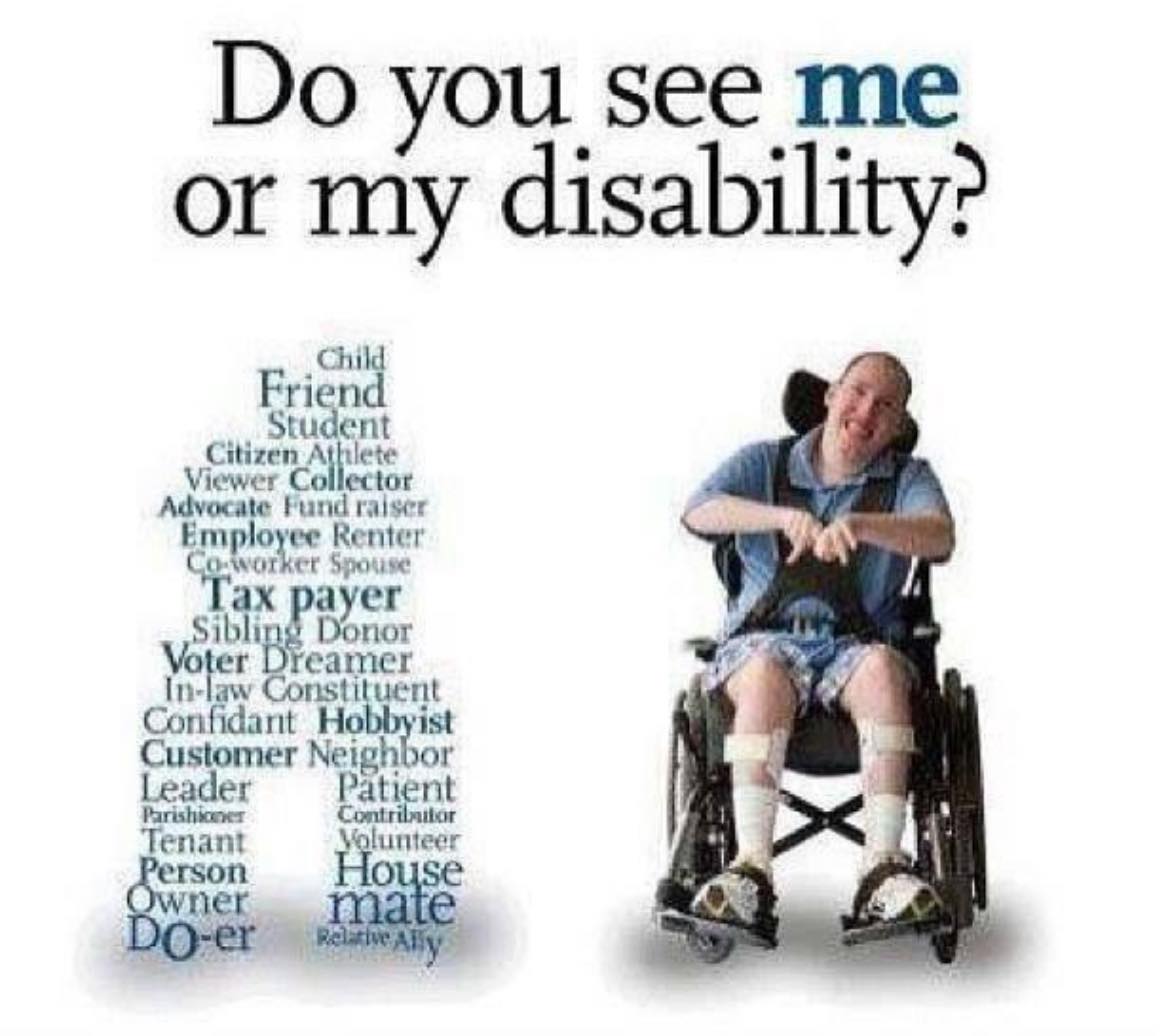
  • Do You See Me?

    Do You See Me?

    Do you see me or my disability?

    See me first! Not my wheelchair.

    Look past my failures and faults.

    Look past my frailties.

    Look past my sickness.

    Look past my disability.

    Look past my wheelchair.

    There’s more to me than what you see.

  • Changing the Narrative

    The religious model of disability.
    It doesn’t just belong to one faith. But it continues to do real harm across many.
    In Western contexts, Christianity has been especially influential, framing disabled people as cursed, sinful, or sent to “teach others” something. We’re turned into metaphors. Our lives become spiritual object lessons.


    But this model appears in other traditions too.


    In some interpretations of Islam, disability is seen as a test from Allah, a reason to be patient or a way to bring others closer to faith. Compassion is encouraged, but pity still lurks.


    In Hinduism, karma is sometimes used to explain disability as a consequence of past-life actions, fueling stigma and shame, even when combined with stories of divine difference.


    Buddhist views can also frame disability as a karmic result or a path toward detachment, encouraging compassion but still casting us as passive or burdensome.


    Judaism has both exclusionary laws and powerful teachings about justice and dignity, some texts limit full participation, but modern re-readings challenge that.


    Even in Indigenous and global faiths, disabled people might be seen as sacred in one context and shunned in another. Culture and theology shape how our bodies are read.
    So it’s not just about belief. It’s about power.


    When religion teaches that some bodies are purer, more sacred, or closer to enlightenment than others, it makes it easier to ignore injustice. It’s not enough to preach compassion while voting for cuts. Or pray for healing instead of fighting for access.


    But I respect the many people of faith who build real community, who fight inequality, and who welcome difference without trying to fix it. That solidarity matters.


    But we have to name the harm too.
    We don’t need to be healed.
    We need to be heard.

  • Learning Disability Week

    Learning Disability Week takes place annually during the third week of June. In 2025 Learning Disability Week starts on Monday June 16 June. The theme this year is ‘Do you see me?’, which is all about people with a learning disability being seen, heard and valued.

    This Learning Disability Week we are asking you to help us walk 1.5 million steps to help raise funds and awareness for the 1.5 million people in the UK with a learning disability.

    You’re welcome to join us anytime during our celebration! At 12pm, we meet at St. John’s Ben Rhydding Church for a picnic in the hall. Bring a packed lunch, drinks provided.

    The One Big Walk for Mencap starts at 1pm. it is a 1.5 mile walk into Ilkley. There is a suggested donation is £1.50 per person to Mencap.

    By 2:30pm, we meet at Outsisde the Box Cafe in Ilkley and bring some money to buy their delicious refreshments.The walk is wheelchair friendly but if walking is difficult, you can take the train from Ben Rhydding to Ilkley or book a taxi. If you need one to one support, please invite your carer to join you.

    Please wear comfortable shoes and clothing suitable for walking. Bring a packed lunch, money and any medication you need. There will be information tables at St. John’s and Outside the Box Cafe about local disability groups.

    Family, friends and carers are all welcome. We hope you enjoy it!

  • LEAN MANUFACTURING

    What is LEAN?

    Lean manufacturing is a methodology for maximizing customer value while minimizing waste in production. In practice, it means streamlining processes to only use the necessary resources and eliminate activities that don’t add value.

    USES and ORIGINS OF LEAN Manufacturing

    Lean’s origins trace back to the Toyota Production System (TPS) developed in Japan after WWII. Faced with resource shortages in the 1950s, Toyota engineers Taiichi Ohno and Eiji Toyoda pioneered a discipline of eliminating waste and continuously improving processes to do more with less. TPS introduced practices like just-in-time production and jidoka (built-in quality) which formed the foundation of Lean manufacturing.

    Productivity + Quality + Costs = Profitability

    PHILOSOPHY

    One of Lean Manufacturing’s foundations is Kaizen, which means continuous improvement. Kaizen is a management philosophy that involves the entire organization in improving processes, products, and services. It focuses on waste elimination and increasing value for the customer.

    Toyota 1950- Henry Ford started first

    1990s- the rest of the world followed

    Eight Types of Wastes

    • inventory
    • transportation
    • overproduction
    • overprocessing
    • underutilised people
    • scraps
    • efforts
    • movement

    LEAN Principles

    These five principles – Value, Value Stream, Flow, Pull, and Continuous Improvement – provide a high-level guide to implementing Lean. Next, we’ll dig into some specific tools and concepts (the “Lean toolbox”) that support these principles day-to-day.

    • value
    • value stream
    • flow
    • pull
    • perfection

    Benefits of LEAN

    • Increased efficiency: Streamlining processes to eliminate waste and improve productivity. 
    • Reduced costs: Lowering operational costs by minimizing waste and optimizing resources.
    • Improved product quality: Enhancing the quality of products through continuous improvement practices. 
    • Higher customer satisfaction: Delivering better value to customers by focusing on their needs and reducing lead times. 
    • Enhanced team engagement: Fostering a culture of continuous improvement and collaboration among team members.These benefits contribute to a more agile and responsive organization.

    Morale and Motivation improves

    PDCA Improvement Cycle (Deming)

    It’s often helpful to follow a structured model like PDCA (Plan-Do-Check-Act) for each change: plan the improvement, do it (on a small scale), check results, and act to standardize if successful. At this stage, you may be running multiple Lean projects in parallel (under the coordination of your Lean team).

    Flow Process Analysis

    The American Society of Mechanical Engineers Symbols- deploying flow process analysis

    Lean Manufacturing: Principles, Tools, Case Studies (2025 Guide)

    Understanding Lean Manufacturing | KAIZEN Article

  • Death with Dignity

    In the United States, assisted suicide, more formally known as “Death with Dignity,” is legal in several states.

    Three Types of Assisted Suicide:

    • TLS (Termination of Life Support) – Involves stopping medical procedures that keep a critically ill person alive.
    • PAS (Physician-Assisted Suicide) – When a doctor provides a patient with the means to end their own life, typically by prescribing a lethal dose of medication.
    • Euthanasia (mercy killing) – The act of intentionally ending someone’s life to relieve them from suffering.

    What Does the Bible Say?

    • Human life is made in God’s image. Human life is a sacred gift and a basic and intrinsic good.

    Death is an enemy and normal part of life. Death was not a part of God’s plan. It came into the world as a result of the entrance of sin (Rom. 5v12; 1 Cor. 15v21–22)

    • Taking an innocent life is a sin. (Ex 20v13)
    • God is the only one who can end life. (Heb 9v27)
    • Take care of the dying. We are obligated to care for the most vulnerable, which throughout the biblical period clearly included the dying.
    • Suffering has redemptive value.

    Arguments for Assisted Suicide:

    • Autonomy Argument: Individuals should have the right to choose the timing and manner of their death.
    • Compassion Argument: Assisting in the death of a suffering individual can be seen as an act of mercy, relieving them from unbearable pain and suffering.
    • Quality of Life Argument: Some argue that when a person’s quality of life is irreversibly diminished due to illness or suffering, they should have the option to end their life.
    • Death with Dignity Argument: The desire to die with dignity, rather than endure a prolonged process of dying, is cited as a reason for PAS/euthanasia.
    • Reducing the Burden Argument: Some believe that choosing death can be a way to avoid becoming a burden on families or the healthcare system.

    Sample advance directive from Melinda Penner of Stand to Reason: https://www.thegospelcoalition.org/ar…